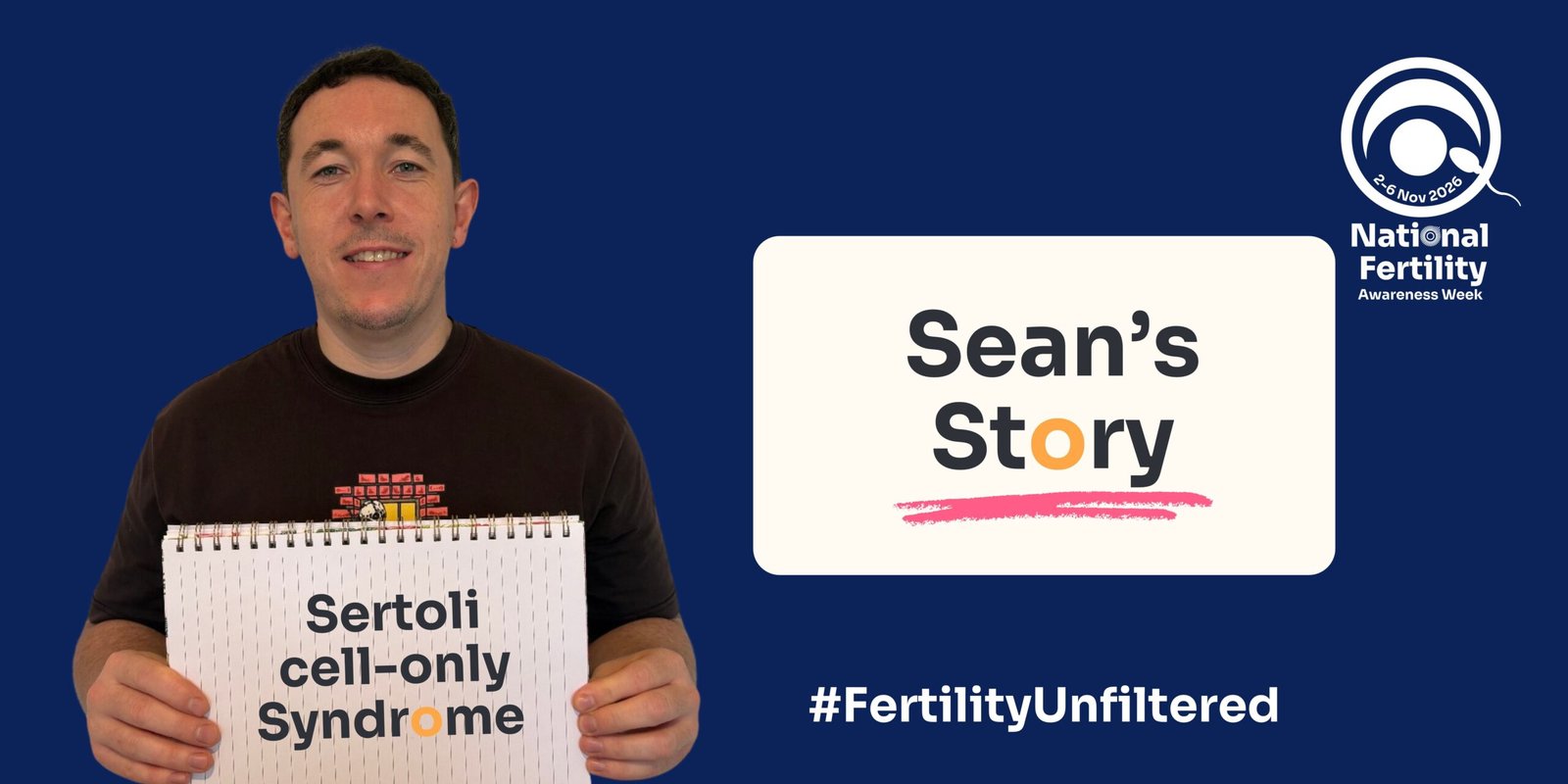
After years of trying to conceive, Bronté and I had tests via our GP.
A result we never expected
In August 2023, after my first semen analysis, I was told there was no sperm detected in my sample, this came as a total shock and filled me and Bronté (my fiancée) with worry. I repeated the test but got the same result and so we started doing our research about Azoospermia. I had never heard of Azoospermia, so this was all new to me and naturally I was very upset. I was told that it would be over a year before I would even speak to a urologist through the NHS, and even longer before I would see someone in person or have any additional tests. With a result of no sperm, we wanted answers sooner than that.
We booked a consultation with Jonathan Ramsey in 2023, and I repeated a semen analysis two more times. Now, after four tests, we knew there was something very wrong as no sperm was present.
Surgery and a diagnosis
In short, we were given two options: ‘micro-TESE’, a surgical procedure to find and retrieve sperm directly from the testicles, or ‘FNA mapping’, which uses fine needles to check different areas for sperm first. We chose FNA mapping because it’s less invasive and doesn’t carry the same risk of needing testosterone replacement therapy (TRT) afterwards.
After a lot of consideration, in March 2024 I went under the knife, 18 samples were taken from each testicle, 36 samples in total and like a biopsy, each tissue sample was analysed. In all 36 samples, only Sertoli cells were found and a month later I was given my diagnoses of ‘Sertoli cell-only syndrome’. A rare condition that causes Non-Obstructive Azoospermia, meaning I cannot pass on my genetics. Imagine being told at the age of 35 that you cannot have children. Of course, there are alternative routes to parenthood but the only path where, as a couple, we get to experience a pregnancy would be through IVF with donor sperm.
Another rare diagnosis
Still in shock, in the months that followed, Bronté had a routine ultrasound booked in preparation for IVF, during this and in the subsequent MRI scan, we found out that Bronté has a very rare uterine abnormality where she was born with only half a womb. We were told that a pregnancy resulting from IVF would be risky as the baby would only have half the space to grow and would likely be premature.
After trying to digest all the news, we persevered.
One NHS round, with conditions
We’re from Birmingham so our local NHS funding body, Birmingham and Solihull Integrated Care Board, told us we would be eligible for one round of IVF but that we had to use the on-site sperm bank, part of the trust.
We were given the only remaining three options (there hasn’t been a sperm donation drive since pre 2020). The only options did not match any of my characteristics, and one donor had admitted to being an occasional drug user so we asked the trust if we could find our own sperm donor using an external sperm bank and still use our one round of IVF. They said no. We appealed it but the unit director at the time refused to let us part fund our round.
Self-funding to keep going
So, we remortgaged and used £30,000 to buy donor sperm and fund two rounds of IVF privately. I’m cutting a lot of the story out here, like all hopeful parents, we have been through a lot of trauma and for me to be told you’ll never pass on your genes hurts a lot.It takes a lot of resilience as a couple to say: I still want this, no matter what, and put your faith in IVF, and importantly, start learning about donor conception.
Over the last two years (2024-2026) we’ve had two full rounds of IVF at two different clinics, and a total of four embryo transfers.
Two embryos did not implant.
One did, but Bronté had a biochemical pregnancy, a very early pregnancy loss. For those of you who have been through the same thing, well, you’ll know the pain.
Ready to be a father
I am ready to be a father through donor conception, and I will be forever grateful for the opportunity to do that. Donor conception is incredibly complex, but it’s also wonderful, and I am hopeful that we will be parents soon.
By Sean Farrell
If anything in this story has stirred up feelings for you, please know you’re not alone, and there are people who understand. Alongside Fertility Action, Donor conception network and Paths to Parenthub offer support and information.