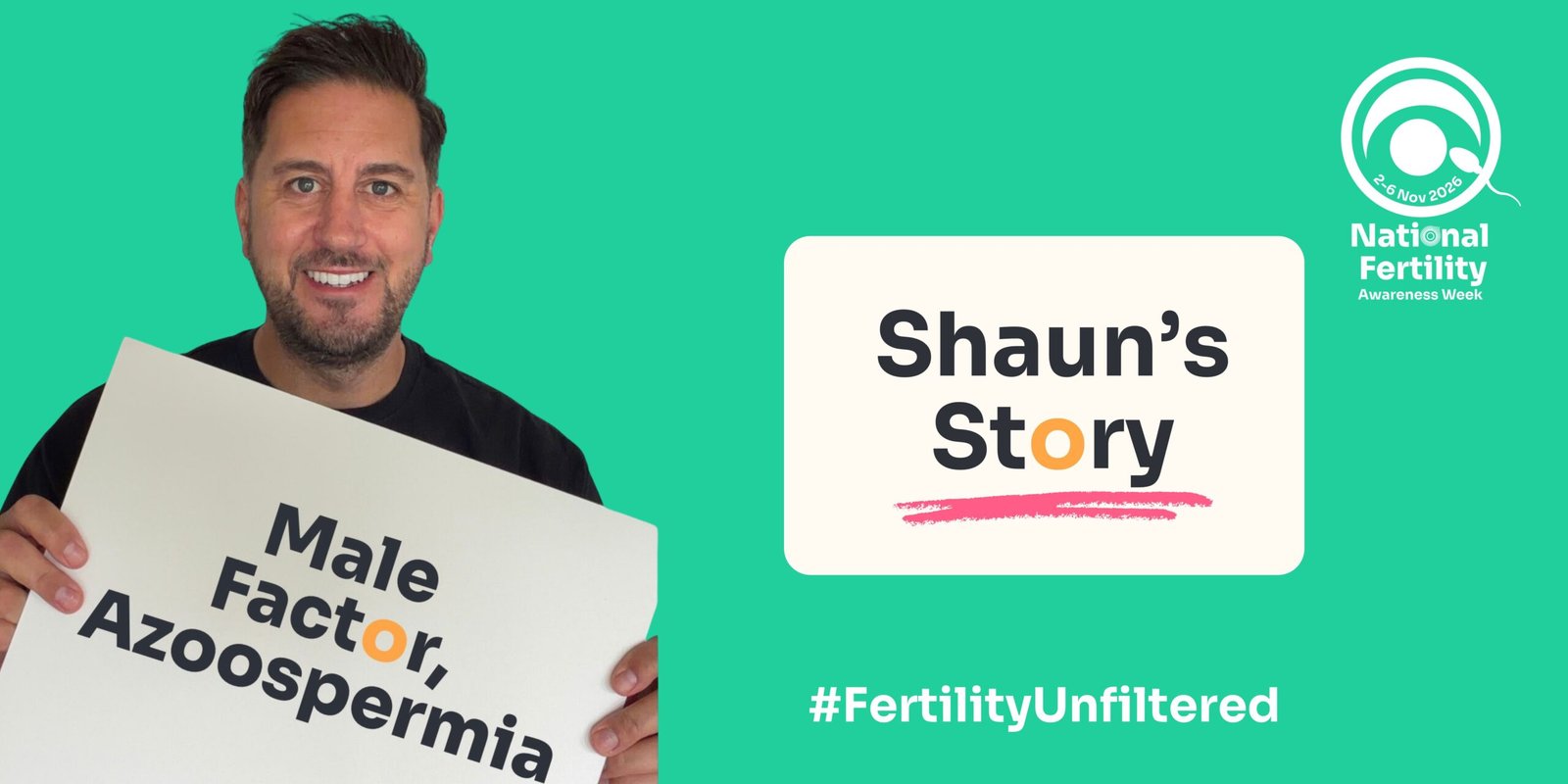
When we talk about fertility struggles, the focus has historically almost always been on women. In many ways, this is understandably so. They’re often the ones going through the physical demands of treatment, the injections, procedures and other medications. But somewhere along the way, we’ve overlooked the men who are going through it too.
I know, because I was one of them.
I’m Shaun Greenaway. A husband, and proud father of twins. But the road to becoming a dad was far from a straight line for me.
The phone call that changed everything
In 2017, my wife Jenna and I decided we were ready to start a family. Like most couples, we assumed it would happen easily and naturally. But after a year of trying, we found ourselves wondering why things weren’t happening, so we went to our GP to try and get some help and potentially some answers.
Then came the phone call that changed everything.
I was diagnosed with azoospermia, a condition where no sperm is present in the semen. Mine was believed to be linked to complications from mumps in my early twenties.
Suddenly, the future we’d imagined together felt very uncertain.
What followed were two operations in 2019. The second, which was a very invasive procedure called a micro-TESE, involved searching directly inside my testicles for any viable sperm.
Neither worked.
There was no sperm to be found, and with that came the realisation that I would never become a biological father. I struggled far more than I ever expected.
Carrying feelings I barely understood
I’d always considered myself a fairly confident, capable man. But infertility challenged things I’d never previously had reason to question. My masculinity, my identity, my self-worth. I felt embarrassed, ashamed and responsible for what was happening to us.
And perhaps one of the hardest parts was watching Jenna face the prospect of IVF, knowing what she would have to endure physically and emotionally.
I knew she didn’t blame me. But that didn’t stop me blaming myself.
We were experiencing the same fertility struggle, but in very different ways. Jenna had her own fears and emotions to navigate. Meanwhile, I was carrying around feelings I barely understood, let alone knew how to communicate.
Looking back now, I can see that much of what I was experiencing was grief. Not only for the biological children I would never have, but for a future I’d always assumed would be mine. It took time, some difficult conversations and a lot of personal reflection to work through that.
Becoming a dad
Eventually, Jenna and I decided to pursue IVF using donor sperm. It wasn’t a decision we made lightly, and I needed time to come to terms with what it meant for me. But I began to understand that being a father was about far more than sharing genetics.
In February 2021, our twins, Ray and Evelyn, were born.
Becoming their dad has been the greatest privilege of my life. All those fears I once had about bonding, belonging and whether I would feel like their ‘real’ dad seem so distant now.
But becoming a father didn’t erase what we’d been through. Those experiences are still part of me, and they’ve shaped much of what I do today. I like to think it made me a better, stronger version of myself, and thus a better husband and father.
Creating the support I couldn’t find
Throughout our fertility journey, one thing struck me repeatedly. I couldn’t find other men openly discussing what I was experiencing. There was plenty of medical information available, but very little about the emotional reality of male infertility. I desperately wanted to hear from someone who understood. Someone who could reassure me that the feelings I was having weren’t unusual.
That absence of support eventually became my motivation to start sharing my story publicly, initially through Instagram, with an aptly named handle: Knackered Knackers, and later through co-hosting The Male Fertility Podcast and eventually by co-founding a support platform called The Male Fertility Hub.
What started with sharing our own experiences has grown into a community where men can talk openly, access support and connect with others who genuinely understand what they’re going through.
Why the conversation needs to change
And the more men I speak to, the more convinced I become that we need to change the wider conversation.
Male factors are involved in close to half of infertility cases, yet fertility is still so often presented as predominantly a women’s issue. That needs to change. But raising awareness isn’t about pointing fingers at men or making them feel responsible. Believe me, many are already carrying more than enough guilt.
It’s about recognising that infertility affects men too, physically, psychologically and emotionally. It’s about encouraging earlier conversations, better education, appropriate medical investigations and making sure men feel included and supported throughout the process.
It’s also about recognising the impact on relationships, workplaces and mental health. And acknowledging that not every fertility journey ends with children, something we must never lose sight of.
Women absolutely deserve the attention, care and support they receive, and more besides. And I believe men deserve a meaningful place in that conversation too.
Because when we overlook men’s experiences, we risk leaving them isolated at a time when they need connection most.
No man should face this alone
I often think about the man I was back in 2018, sitting with a diagnosis I didn’t understand and emotions I couldn’t explain. If he’d been able to hear from someone who had walked that same path, I think things might have been very different. It’s that which drives me today.
I want male infertility to become something we can discuss openly, without embarrassment, shame or judgement. Something we recognise as an important part of men’s health generally, rather than a subject that only comes up when couples struggle to conceive.
And ultimately, I want every man facing fertility challenges to know that whatever his diagnosis, whatever his circumstances and whatever his future holds, he doesn’t have to navigate it alone.
By Shaun Greenaway
If anything in this story has stirred up feelings for you, please know you’re not alone, and there are people who understand. Alongside Fertility Action, The Male Fertility Hub offer support and information.