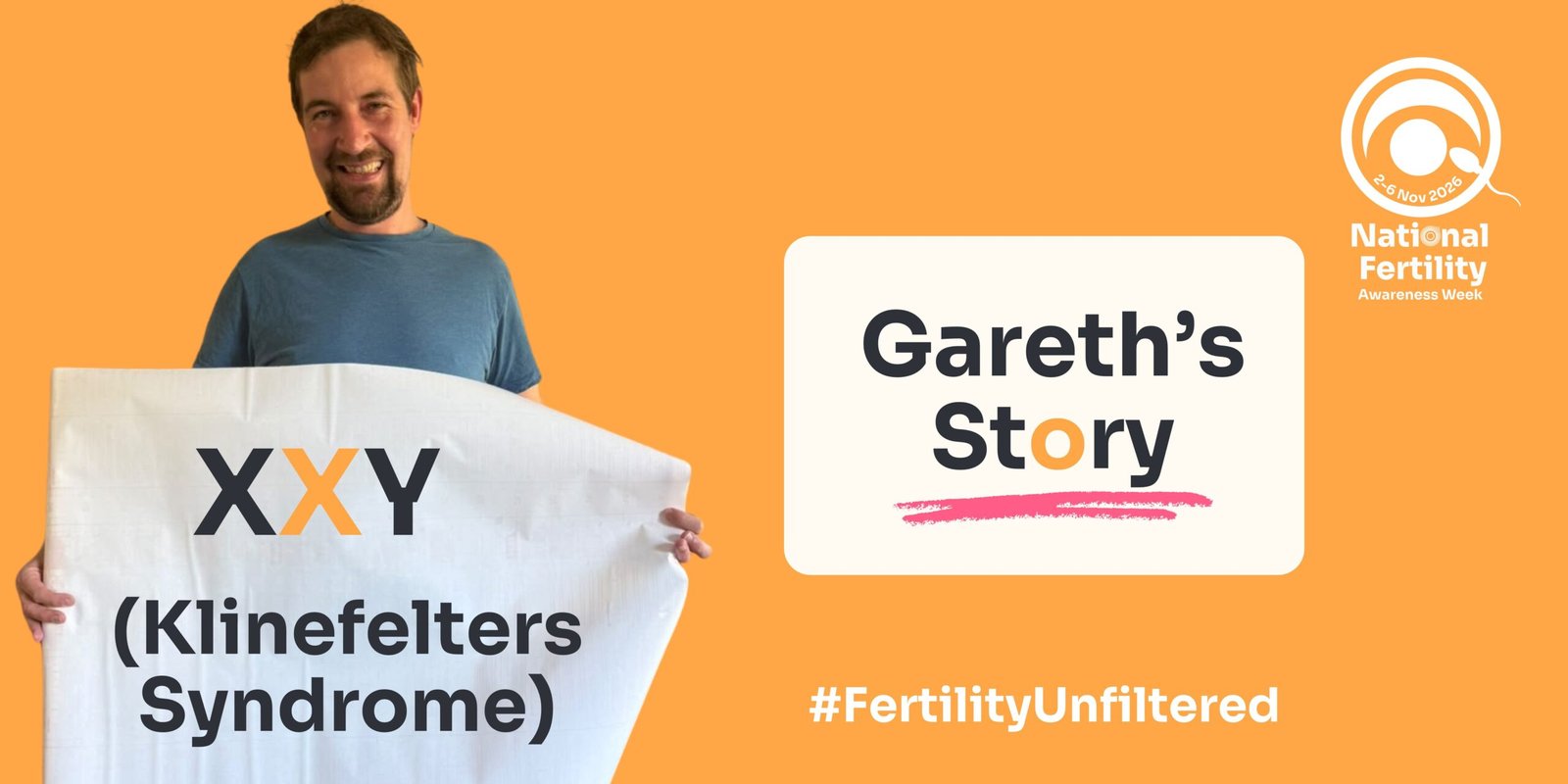
When Gareth Landy discovered he was XXY, he was trying to become a father. What followed was a path of medical uncertainty, the loss of an imagined future and the possibility of finding meaning somewhere unexpected. Today, he is determined to change the conversation around male infertility – and to challenge the idea that a man’s worth is measured by what his body can produce.
There are certain moments in life when the story we have been telling ourselves comes abruptly undone. Sometimes the change is obvious: a relationship ends, a job disappears, a person we love dies. Sometimes it arrives in the language of medicine, delivered in a consultation room under fluorescent lights, where a handful of unfamiliar words can alter the shape of everything that comes afterwards.
For Gareth Landy, that moment came in 2017, when he and his wife, Anna, were trying to conceive.
Gareth discovered that he was XXY, a genetic condition in which a male is born with an additional X chromosome. Also known as Klinefelter syndrome, it can affect testosterone production and fertility. For some men, the diagnosis comes in childhood or adolescence. For others, it remains undiscovered until adulthood, sometimes when they begin trying to have children.
For Gareth, the diagnosis arrived at the point when the future had begun to acquire a particular shape. He and Anna were trying to start a family. Like many couples, they were moving towards a life they could imagine but had not yet experienced. Then, suddenly, the question was no longer simply when they might become parents. It was whether Gareth could father a biological child at all.
A question he never expected to ask
There is something especially difficult about discovering a limitation in a part of yourself you have never had reason to question. We tend to assume that our bodies will cooperate with our plans. We may know, in theory, that conception is not guaranteed, but it is one thing to understand this as a fact about other people and quite another to find yourself inside it.
Male infertility carries its own particular burden. We live in a culture that has become increasingly willing to discuss women’s reproductive health, although significant silences remain. Men’s fertility, by contrast, can be obscured by a persistent and unhelpful association between reproductive capacity and masculinity. The assumption that a man should be able to father a child is rarely stated outright. Its power lies in the fact that it often goes unquestioned.
When that assumption falls away, a man may find himself confronting not only a medical problem but a more personal question: what does this mean about me?
We should be careful not to presume that every man with XXY will ask himself that question, or that every man will experience the diagnosis as a crisis. People are not interchangeable, and neither are their responses to difficult news. But the possibility of such questions is one reason Gareth’s story deserves to be heard.
The particular cruelty of hope
Gareth and Anna’s first consultation with a urologist was devastating. Their fertility challenges were confirmed, and they were left to consider the possibility that the family they wanted might not come about in the way they had hoped.
They sought a second opinion, which led them to Consultant Urologist (and Trustee of Fertility Action) Jonathan Ramsay. Under his care, they learned that there was a possibility Gareth might still produce sperm.
Hope returned, but it was not the uncomplicated kind.
Anyone who has navigated a difficult medical pathway will recognise the strange emotional arithmetic involved. A possibility can feel like a reprieve. It can also become another thing to lose. Each new appointment offers the chance of a different answer, while making the prospect of disappointment more concrete. You learn to live in the space between what might happen and what you are afraid will happen.
Gareth underwent two testicular operations and months of hormone treatment. He and Anna continued along a pathway that required patience and resilience, although resilience is one of those words we tend to use most readily when describing people who have had little choice but to endure.
Eventually, the answer came. Gareth was infertile.
There would be no sperm found that would allow him to father a biological child using his own sperm. The possibility they had pursued had come to an end.
It is tempting to describe such a moment as a turning point, as though life divides neatly into a before and an after. In reality, the emotional consequences of difficult news are often less orderly. There is the immediate impact of the answer itself, followed by the slower work of understanding what it means. There are practical decisions to make, conversations to have and expectations to reconsider. There may be sadness, anger, relief at finally knowing, or several conflicting emotions at once.
For men living with XXY, the diagnosis can raise questions that extend beyond fertility. What does it mean to have a condition you may never have heard of? How much should it define you? Who should you tell? What happens when the body does not behave as you assumed it would?
These are not questions with universal answers. Nor should they have to be answered all at once.
One of the things that can make a diagnosis feel isolating is the impression that everyone else has received a set of instructions for life that you somehow missed. You may find yourself learning new terminology, navigating specialist care and attempting to understand a future that has suddenly become less predictable.
The value of hearing another person’s story is not that it tells you what to do. It is that it reminds you that you are not the only person trying to work it out.
The family they found
Gareth and Anna eventually decided to use donor sperm. After three rounds of IVF, their twins were born in November 2019.
Their family came into being by a route different from the one they had initially imagined. That difference matters, but it does not have to diminish what followed.
There is a tendency to think of parenthood as a single destination reached by a single road. In reality, families are made in many different ways, through biological conception, donor conception, adoption, fostering and other paths. Some people will pursue treatment; others will decide that it is not right for them. Some will find peace in a life without children. None of these outcomes should be treated as a verdict on the person living them.
For Gareth and Anna, donor conception became the way forward.
It would be wrong to suggest that the arrival of their twins erased everything that had preceded it. The fact that a person finds happiness after a loss does not mean the loss was insignificant. Nor does becoming a parent necessarily resolve every feeling associated with infertility.
Human beings are capable of holding apparently contradictory truths. We can be grateful for what we have and sad about what we did not get. We can love the life we have built while acknowledging that it differs from the one we first imagined.
Perhaps this is one of the less discussed aspects of fertility difficulties: the challenge is not always to find a way to stop feeling sad. Sometimes it is to make room for sadness without allowing it to occupy every available space.
For anyone with XXY who is considering their fertility options, Gareth’s experience offers a reason to seek informed, individualised advice and to understand that there may be different routes to building a family. It does not promise a particular outcome. XXY affects people differently, and fertility options vary from one individual to another.
But it does show that a medical diagnosis does not have to dictate every subsequent chapter.
What happens when you tell the truth?
In 2021, Gareth was invited to share his experience on a podcast hosted by the American non-profit organisation Living with XXY.
The response from friends and family was overwhelming. Many encouraged him to do more interviews.
Since then, he has recorded more than 50 interviews across three continents, raising awareness of male infertility.
It is striking how often a private experience becomes a public mission only after someone discovers the extent to which other people need to hear it. Gareth’s diagnosis had been personal, his treatment intimate, his fertility outcome his own to process. Yet the act of speaking about it revealed that his experience could mean something beyond himself.
Perhaps there is a particular freedom in naming something that has previously been difficult to discuss. Shame, after all, depends partly on secrecy. It flourishes when we believe that our experience makes us unusual, deficient or somehow less entitled to belong.
Speaking openly does not magically remove these feelings. Nor should anyone be expected to turn a painful experience into a public service. There is no obligation to disclose a diagnosis, to educate strangers or to become an ambassador for a condition simply because you live with it.
But when people do choose to speak, they can change the conditions in which others understand themselves.
Gareth’s interviews help bring male infertility into conversations from which it has too often been absent. They create opportunities for men to recognise aspects of their own experiences in someone else’s story. They also challenge the idea that infertility is a problem that affects women alone, or that a man’s silence is evidence that he is coping.
In 2023, Gareth became a TED Talk speaker, using his personal journey to advocate for societal change in the way men experiencing fertility difficulties are supported.
In 2024, he presented on the subject to members of the Irish government at Leinster House. In October 2025, he returned to the political arena with a panel of leading experts to speak to members of Stormont in Northern Ireland.
The progression from a podcast to a TED Talk and then to political institutions suggests something important about the nature of advocacy. A personal story can open a door, but the ultimate aim is to change what happens beyond it.
Men need access to appropriate medical care, reliable information and support that recognises the emotional consequences of infertility. Those living with XXY need to be understood as individuals, not reduced to a chromosome or a presumed set of symptoms. And society needs to become more comfortable with the fact that masculinity is not a medical test that some men pass and others fail.
A body capable of extraordinary things
In 2026, Gareth completed his sixth marathon, raising awareness and funds for Fertility Action. This year, he has also taken on three endurance events, with a message directed particularly at men: if you don’t have sperm, you can still do extraordinary things.
It is a powerful statement, not because running a marathon proves anything about a man’s worth, but because it challenges the assumptions that can attach themselves to infertility.
There is a risk, of course, in replacing one measure of masculinity with another. Men should not have to run six marathons, complete endurance challenges or achieve anything remarkable to demonstrate that they remain worthy of respect. A man who never runs a mile is no less complete than a man who runs hundreds.
The deeper point is that fertility is only one aspect of a person’s physical life, and it is not a measure of their character, courage or capacity to contribute to the world.
Gareth’s endurance events make that message visible. They turn an issue that is often discussed in private into something that can be seen, shared and supported. They also provide a way for him to raise money and awareness while demonstrating that the body can be understood in terms other than reproduction.
The body that could not produce sperm is also a body capable of extraordinary physical effort. Both things are true. Neither cancels out the other.
There is something quietly radical about refusing to let one fact become the whole story.
The danger of defining ourselves by what we lack
A diagnosis can be useful. It can explain symptoms, guide treatment and connect someone with appropriate support. But there is a difference between having a diagnosis and becoming defined by it.
For a person newly diagnosed with XXY, it may take time to understand what the condition means for their own health, fertility and future. The information may arrive all at once, while the emotional response takes much longer to emerge. Some people may feel the need to find others with the same diagnosis; others may prefer to process the information privately. Some may want to pursue fertility treatment; others may decide against it.
There is no correct timetable for acceptance, and there is no prize for appearing unaffected.
What Gareth’s story offers is not a neat narrative in which adversity becomes opportunity and every painful experience is redeemed by a greater purpose. Such stories can be comforting, but they can also impose an unfair burden on people who are still struggling. Not every disappointment needs to become a lesson. Not every person needs to transform their pain into activism.
Instead, Gareth’s journey demonstrates something more humane: a person can experience a significant loss and still have a life that is expansive, complicated and meaningful.
He and Anna became parents. Gareth found a public voice. He has spoken to audiences across continents, addressed political representatives and undertaken endurance challenges to raise awareness and funds. These achievements do not make his infertility less real. They show that it was never the sum total of who he was.
For other men with XXY, the reassurance lies not in the promise that their pathways will resemble his, but in the possibility that their lives can take many forms.
A different definition of fatherhood
We often speak about fatherhood as though it begins with conception. But the relationship between reproduction and parenting is not as straightforward as cultural assumptions suggest.
Gareth’s path to having children required him and Anna to reconsider the role of biological connection in the family they wanted to build. Donor conception was not the route they had originally envisaged, but it enabled them to become parents.
That experience may raise questions for other men in similar circumstances. How important is a genetic connection? What does fatherhood mean when conception takes place using donor sperm? How might a person process those questions over time?
These are deeply personal matters, and people may arrive at different answers. They deserve honest discussion, free from the suggestion that there is only one legitimate way to experience fatherhood.
Biology matters to some people in particular ways. For others, the relationships they build, the care they provide and the life they share with their children become the more significant measures of family. Neither response needs to invalidate the other.
The important thing is that men are allowed to explore what fatherhood means to them, rather than being handed a definition that leaves no room for difference.
Gareth’s story makes space for that conversation. It asks us to look beyond the question of whether a man can produce sperm and consider the much larger question of how he wants to live.
The story is not over
Gareth Landy’s journey began in 2017 with a diagnosis he had not anticipated and a question he and Anna had hoped would have a straightforward answer. It took them through difficult medical consultations, two operations, months of hormone treatment and the final confirmation that Gareth was infertile. It led to donor conception, three rounds of IVF and the birth of their twins.
Then, in a way he could not have predicted, it led to advocacy: more than 50 interviews, a TED Talk, presentations to politicians and a series of endurance challenges intended to change the conversation around male infertility.
It would be easy to call this a story of overcoming adversity. But that phrase risks suggesting that the only acceptable response to hardship is to conquer it, emerge stronger and offer an inspiring account of the process.
Gareth’s story is more interesting than that.
It is about what happens when the future you expected becomes unavailable, and you have to work out what remains possible. It is about the difference between accepting a fact and allowing that fact to define you. It is about the power of telling the truth, particularly when the truth concerns something society has made difficult to discuss.
Most of all, it is a reminder that there is no single test a man must pass to be considered whole.
For someone living with XXY, the future may involve fertility treatment, donor conception, a different route to parenthood or a decision not to have children. It may involve questions that take years to resolve, or feelings that change as life unfolds. There is room for uncertainty, for grief and for hope, without any one of them having to tell the entire story.
Gareth has chosen to use his experience to make that room larger for other men. His work invites them to speak if they wish, to seek support when they need it and to understand that infertility is a condition they may experience, not a definition of who they are.
Perhaps the most important thing we can learn from his pathway is not that a person can achieve extraordinary things despite infertility. It is that he should never have needed to prove his worth in the first place.
A man is not defined by what his body can produce. He is defined by the life he lives, the relationships he builds and the meaning he chooses to make.
If anything in this story has stirred up feelings for you, please know you’re not alone, and there are people who understand. Alongside Fertility Action, the Klinefelter’s Syndrome Association, The Male Fertility Hub, and The Donor Conception Network offer support and information.