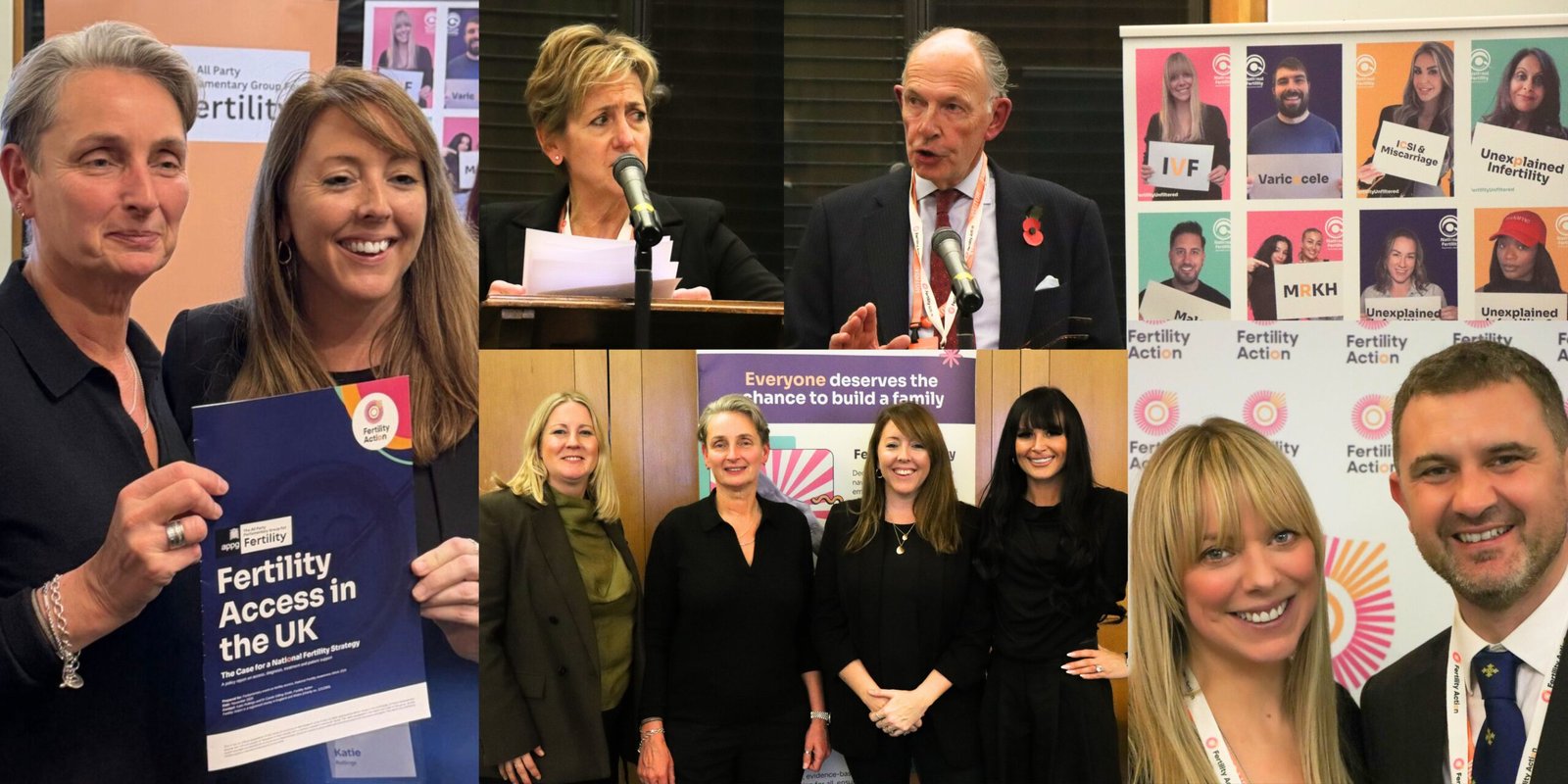
Last night, in the heart of Westminster, we joined together to say it loud and clear: fertility access in the UK has to be fair, for everyone.
On Wednesday 4 November, in Portcullis House, the All-Party Parliamentary Group for Fertility launched its first ever report, Fertility Access in the UK: The Case for a National Fertility Strategy. At the event kindly hosted by Kate Osborne MP, Chair of the APPG, we gathered with parliamentarians, clinicians, advocates and those with lived experience of fertility challenges in one room, to reveal the recommendations of the report and hear the thoughts of some powerful speakers.
We were honoured to prepare the report as secretariat to the APPG, working with Dr Carole Gilling-Smith, Consultant Obstetrician and Gynaecologist, whose years of developing patient pathways and clinical expertise runs through every page.
It has been months in the making. Late nights, endless drafts, more cups of tea than we’d care to admit, and many conversations across the sector with people who were generous enough to tell us what really happens when you try to get fertility care in the UK.
What the Report Found
Infertility affects one in six people. The World Health Organization recognises it as a disease of the reproductive system. Yet fertility access in the UK is anything but equal. Whether you receive NHS treatment depends largely on where you live, your relationship status and whether you can afford to pay.
That is the IVF postcode lottery, and the numbers are stark:
- NICE recommends three full IVF cycles for eligible women under 40. Just 3 of the 38 English ICBs with a stated policy fund them. 27 fund just one.
- In 2024, only 25% of IVF cycles in England had NHS funding, compared with 54% in Scotland.
- Across the UK, the NHS-funded share has fallen from 35% in 2019 to 28%.
- The UK scores just 65% on the European Atlas of Fertility Treatment Policies, well behind Belgium, the Netherlands and France.
Even where treatment is funded, local eligibility rules can shut people out. Differing age brackets, BMI limits – being turned away because your partner has a child from a previous relationship. Female same-sex couples and single women being asked to pay for rounds of donor insemination before they can even be referred. Male same-sex couples, and anyone who needs surrogacy to pursue their wish for biological parenthood, face some of the biggest barriers of all.
These differing and unfair rules are having a massive impact on people’s lives. Behind every statistic is a person, a couple or a family facing uncertainty, difficult decisions and, often, profound grief. A recent case study commented; “We moved our entire lives up to Bristol because we thought it would give us the chance to access IVF through the NHS.”
The cost of putting this right? NICE estimates that funding three full cycles across England would cost about £9.7 million a year more.
Fertility Is Not a Women’s Issue
One of the key messages we heard last night was this: male infertility is a growing problem, it is under investigated, and it deserves equal attention.
Too often, male partners are tested late, or not at all, before referral. That means months of waiting, repeat appointments and delayed answers. The report proposes a simple, practical fix: a nurse-led, one-stop diagnostic pathway, so that core tests for both partners are done before the first specialist appointment.
Fertility is not a women’s issue. Male fertility challenges are very real and deserve equal attention – and men, and people with sperm, must be properly represented in the conversation, in research and in the diagnostic pathway.
Every Voice in the Room
During the evening, we screened a powerful campaign film, created by Joey(our talented Volunteer) and her sister Katie. The film featured black and global majority voices, sharing their own experiences of seeking diagnosis, treatment and support. It had a profound impact on everyone in the room and was a powerful reminder that fertility challenges don’t affect everyone in the same way.
HFEA data shows lower birth rates after fresh embryo transfer for Black and Asian patients, and the reasons are still not fully understood. The same goes for so many others who are too often an afterthought: people on lower incomes, LGBTQIA+ people, single people, and anyone whose fertility is threatened by cancer treatment, endometriosis, premature ovarian insufficiency or gender-affirming treatment.
A national approach has to work for all of them. Every route to parenthood, every postcode and every bank balance.
What We’re Asking For
In the report we have made six recommendations:
- A National Fertility Strategy for the UK, with a clear plan and named accountability in each nation.
- National minimum standards in line with NICE, with ICBs required to publish their policies and explain any departure.
- An independent review of local eligibility criteria, testing each one for fairness and clinical justification.
- A nurse-led, one-stop diagnostic pathway that investigates both partners from the start.
- A national fertility access dataset, so we finally know who is waiting, who is turned away, and why.
- Sustainable funding and workforce planning, with fair access to fertility preservation, psychological support and workplace protection.
A Team Effort
This was never one organisation’s work, and last night proved it.
Thank you to Kate Osborne MP for hosting, for writing the report’s foreword, and for championing this issue in Parliament. Thank you to Dr Carole Gilling-Smith and Professor Jonathan Ramsay for their contributed expertise. And to all of the APPG Members, individuals and organisations who joined us – and of course Laura-Rose, Becky and Katie, who continue to work hard on their collective campaigns and without whom, we may not have all been in that room at all.
Thank you to our wonderful Ambassadors, Liz McClarnon & John O’Neill MBE, for standing alongside us. And a huge thank you to our amazing filmmaker, Joey Clarkson and everyone who took part in the film.
Most of all, thank you to everyone who supported beyond the scenes and to those who courageously shared their story with us. You are the reason this report exists.
Read the Report
The full report is free to read and download
Read it. Share it with your friends, your colleagues and your MP. The more people who see the evidence, the harder it becomes to ignore.
This Is Just the Beginning
Somewhere right now, someone is searching online to find out whether their postcode means they’ll get a fair chance at treatment.
We want the answer, wherever they live, to be yes.