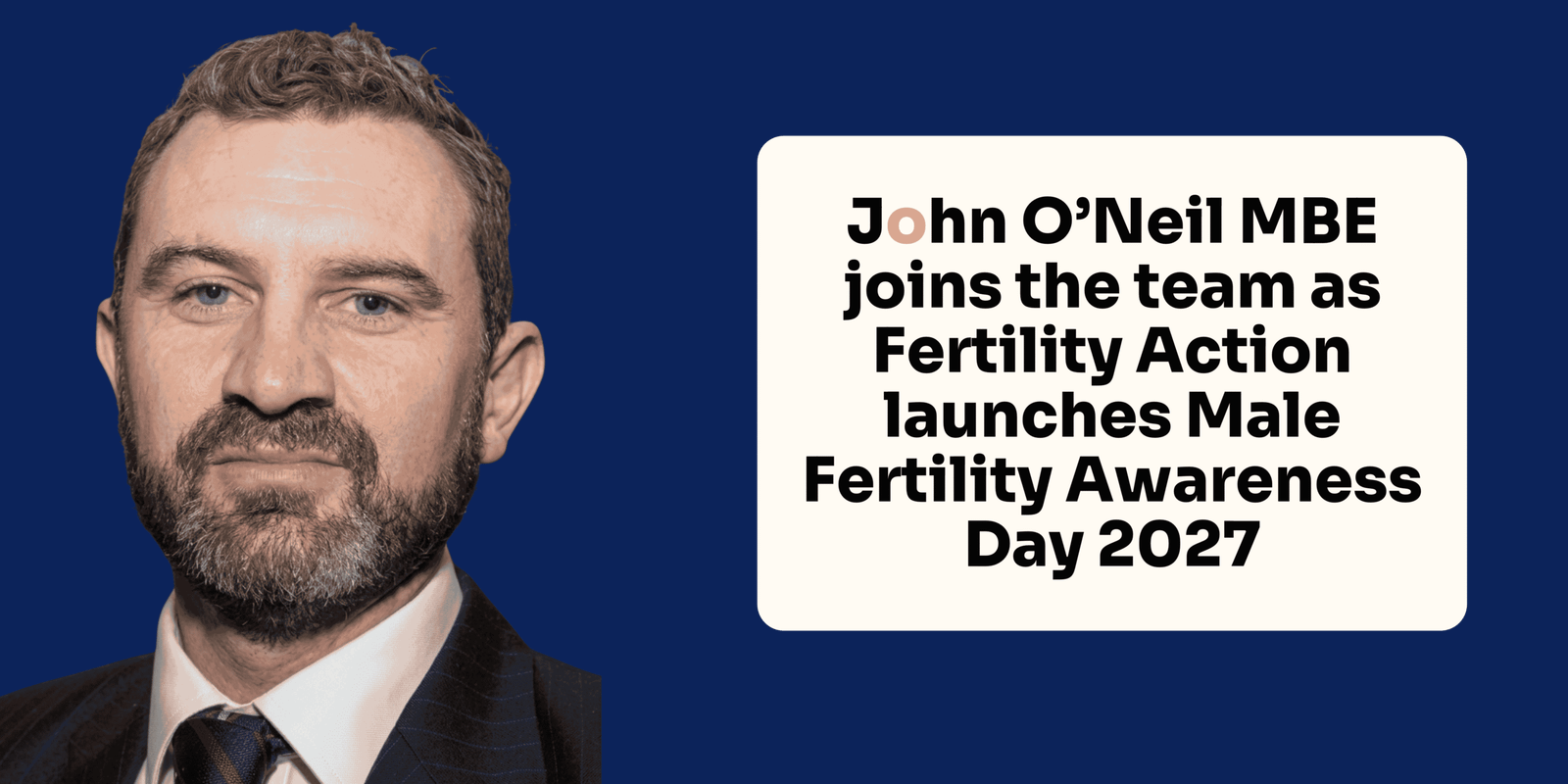
What does fertility really mean for men, and what happens when the journey to parenthood isn’t quite as straightforward as expected?
In this incredibly honest and personal account, our Fertility Action Ambassador shares his experience of male factor infertility, navigating fertility treatment whilst serving in the Armed Forces, and the importance of having understanding and support around you.
From the challenges of speaking openly about fertility at work to the life-changing impact of having colleagues and leaders in your corner, his story is a powerful reminder that fertility is not just a women’s issue, and no one should have to navigate the journey alone.
We’re also proud to announce the launch of Male Fertility Awareness Day on 20 May 2027 – a new initiative to break down stigma, encourage conversations and shine a much-needed spotlight on male fertility.
Johnno’s Story
So… how did I get here?
If you had told me whilst I was undergoing training at the Royal Military Academy Sandhurst that I would provide a voice within Defence promoting fertility support, I wouldn’t have believed you. If you’d told me I’d become an Ambassador for a charity like Fertility Action, advocating nationally for change to support those on fertility journeys, I would have told you that you had the wrong bloke. But I think that’s the point; nobody expects to struggle when seeking to start or build their family.
My experience of sex education lessons at school came with a stringent warning that if you failed to use contraception that a pregnancy was pretty much imminent – so some twenty years later, I wasn’t expecting to be a member of the one in six requiring fertility support. My male factor infertility diagnosis was the primary reason my wife and I were required to undergo three cycles of Intracytoplasmic Sperm Injection(ICSI) in order to build the family that we treasure today.
Fertility is a subject that we as a society, and especially men, struggle to talk about. Words like sex, sperm, or menstrual cycle, can feel uncomfortable and aren’t those we generally like to use in our day-to-day chit chat. Add to that a societal stigma linking virility to masculinity, and it isn’t all thatsurprising that many men don’t openly discuss their fertility journeys, particularly at work. I certainly didn’t… at least initially.
When we underwent our first cycle of ICSI, I was attached to the Royal Marines as a Troop Commander. Needless to say, my low levels of sperm morphology and motility weren’t high on my list to chat about. However, I was forced to confide in my Commanding Officer when there was discussion as to being assigned early, and the level of support I received was incredible. In opening up about our fertility challenges, I was afforded an ally who was prepared to back me, and fought to keep me in Unit, which allowed our treatment to continue. This gave me the confidence to open up further, and I quickly realised I wasn’t alone. Multiple members of the Unit, including my line manager, had experience of fertility challenges and treatment.
It can be easy to feel like a spare part as a man on a fertility journey. Despite the primary medical issue resting on my shoulders, male focused testing was pretty limited. Our journey was further complicated by taking place during the throes of COVID, resulting in delays and appointments where I was left in the car whilst my wife attended tests and treatment due to social distancing protocols.
This was a lonely and isolating experience – I needed to talk.
As we approached the implantation of our only viable embryo, and as COVID restrictions began to lift, I made the decision to tell my Troop what I was going through. I wasn’t seeking sympathy or special treatment; I wanted them to know that I might not be myself for a few weeks due to the stressors that we were under. I was blown away by their response, with everyone from my most junior Lance Corporal to my Sergeant Major checking in with me, taking the time to ensure I was OK, often with a brew/wet (depending on your branch of the Armed Forces) in hand.
One of my favourite memories was telling my Sergeant Major that we had reached the three-month mark of my wife’s pregnancy. I was told “Boss, we know you’re a dirty stinking pongo (Royal Marine slang for members of the Army) but your little one was conceived whilst you were serving in the Corps, so we are claiming it for the Marines” and was presented a baby blanket in Royal Marines colours. If I could receive such a genuine level of support from a bunch of grizzled Commandos, then there is no reason that this can’t be the case across our society.
It was after my first child was born that I reflected on my own experiences. Whilst Defence carries additional challenges when undergoing fertility journeys relating to time apart due to overseas deployments, and regular geographic moves due to the assignment cycle, we are fiercely team focused and seek to support our people. It was at this juncture that I wanted to find ways to support others on fertility journeys and volunteered as the inaugural Army lead of the Defence Fertility Network (DFN).
This led me to stepping through the looking glass and realising the sheer scale and range of fertility journeys that are being endured. I quickly learned that no two fertility journeys are the same, but that those undergoing them all had one thing in common; they were warriors, fighting for the privilege and joy of parenthood. No matter an individual’s gender, sexuality, relationship status, religion, ethnicity, fertility challenge or treatment pathway, this is an incredibly tough journey, and one that shouldn’t be faced alone.
Five years later, I have been privileged to have worked alongside an incredible team of volunteers within the DFN to drive meaningful change. From gaining organisational recognition for the Network, to driving the campaign for Defence to sign the Fertility Support Pledge, one thing has remained central – our people. Our personnel and their partners provide each other a peer network enabling sharing of experience, signposting, and mutual support. There is a genuine strength in community, which brings a confidence that you are not walking the journey alone.
Becoming an Ambassador for Fertility Action is a huge honour. I do not underestimate the privilege of helping to amplify the voices of those navigating fertility challenges, nor the responsibility that comes with advocating for meaningful change. If my own journey has taught me anything, it is that nobody should have to walk this path alone. I am incredibly excited to work alongside Katie and the team to raise awareness, challenge stigma, and help ensure support is there for our community when they need it most.
(Fertility Action will be launching the first ever Male Fertility Awareness Day on 20th May 2027 and we’d love to hear from you if you’d like to be involved).