Surviving cancer shouldn’t mean having to fight for the chance to become a parent.
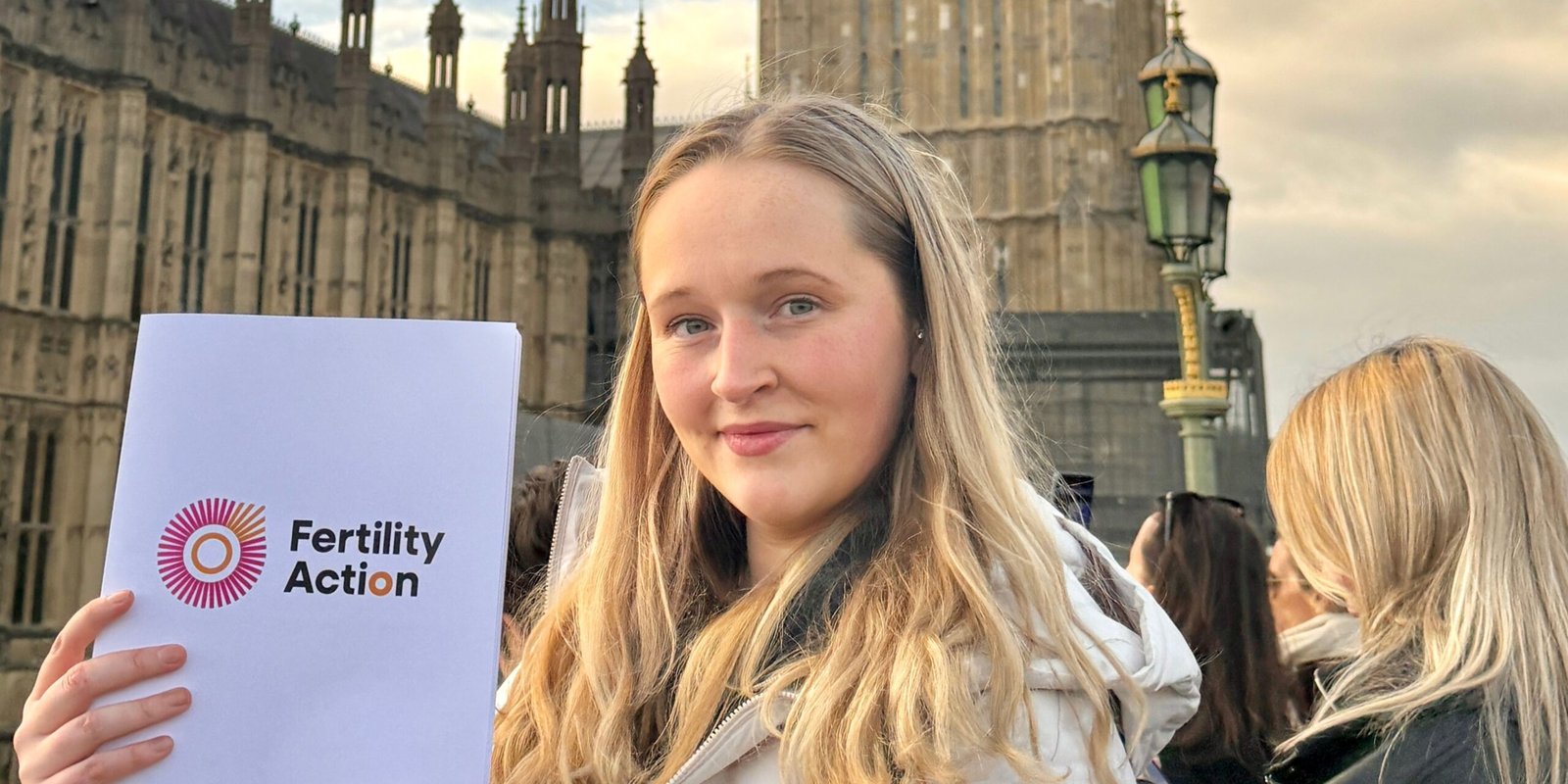
Last week, we were back in Parliament alongside Mollie Mulheron, a cancer survivor from Padiham in Lancashire, to talk to MPs about fertility preservation after cancer and a gap in NHS fertility care that has had a devastating impact on her life.
Hosted by Jess Brown-Fuller MP, the drop-in brought together MPs from across the political spectrum to hear Mollie’s story and discuss the urgent need for change. Her story has also been covered by BBC News and BBC North West Tonight, where Dr Carole Gilling-Smith, Consultant Obstetrician and Gynaecologist, and one of our Trustees, spoke on behalf of Fertility Action and who spoke to MPs with Mollie last year too.
No time to freeze her eggs
At just 24, Mollie was diagnosed with stage four diffuse large B-cell lymphoma. She had been travelling after university when she started to feel unwell. Back home, doctors found a tumour the size of a melon pressing against her heart and lung.
Her cancer was so aggressive that she needed chemotherapy straight away. There simply wasn’t time to freeze her eggs first. Saving her life had to come first, and she was told fertility preservation could be looked at again once she was well enough.
“Doctors and everyone reassured me: “you can probably have it done afterwards, it shouldn’t be a problem…”,” said Mollie, speaking to the BBC
More than 800 hours of chemotherapy and 150 days later, Mollie beat cancer.
Then came a different fight
The treatment that saved Mollie’s life has also taken its toll on her fertility. Her ovarian reserve has more than halved in a year, and she has been warned she may face an early menopause.
When she asked for NHS-funded fertility preservation, her local Integrated Care Board, NHS Lancashire and South Cumbria, told her that her circumstances didn’t meet its funding criteria.
She had no chance to protect her fertility before life-saving treatment. Now she is having to fight for the chance to protect it afterwards.
What’s at stake
NICE guidance recommends offering egg or embryo freezing to people facing treatment that is likely to affect their fertility. But fertility preservation after cancer is far less clear for people like Mollie, who couldn’t preserve their fertility beforehand.
NICE told the BBC that its committee “did not make a specific recommendation on fertility cryopreservation because of uncertainties about the quality and safety of fertility material after treatment.” It added that it recognised “there may be individual circumstances where this could be considered, based on clinical and professional judgement.”
That grey area leaves decisions to local ICBs, so what a cancer survivor can access depends on where they live. It is the postcode lottery again, and for young cancer survivors, the clock is already ticking.
“It is the biggest problem we have at the moment, in this country, with fertility. Each postcode interprets the NICE guidance as they wish and it’s not an acceptable way of practising NHS-funded care,” said Dr Carole Gilling-Smith, speaking to BBC North West Tonight.
We’ve written before about how cancer survivors are being let down by NHS IVF policy.
Turning conversations into action
NHS Lancashire and South Cumbria ICB has said it would welcome a national policy review. So would we.
Thank you to Jess Brown-Fuller MP for hosting, and to Tom Gordon MP, Pippa Heylings MP, Marie Goldman MP and Sir Gavin Williamson MP for taking the time to listen. Thank you too to the offices of Al Pinkerton MP, John Milne MP, Edward Morello MP and Kate Osborne MP for sending staff to engage with this issue.
How you can help
- Follow Mollie’s Instagram page to support her campaign for young cancer survivors.
- Share her story, so more people understand this gap in care.
- Join our Fertility Voices group and add your voice to our calls for fairer fertility care on our Campaigns page.
Thank you, Mollie
Most importantly, thank you to Mollie for sharing her experience so openly and courageously. It takes enormous strength to turn something so personal and painful into a campaign for change.
Everyone deserves the chance to build a family.