Fertility treatment doesn’t stop when the working day begins.
For the growing number of people navigating fertility treatment, IVF, miscarriage, pregnancy loss or other family-building journeys, the workplace can be an important source of support – or an additional source of stress.
So, what does a genuinely fertility-friendly workplace look like?
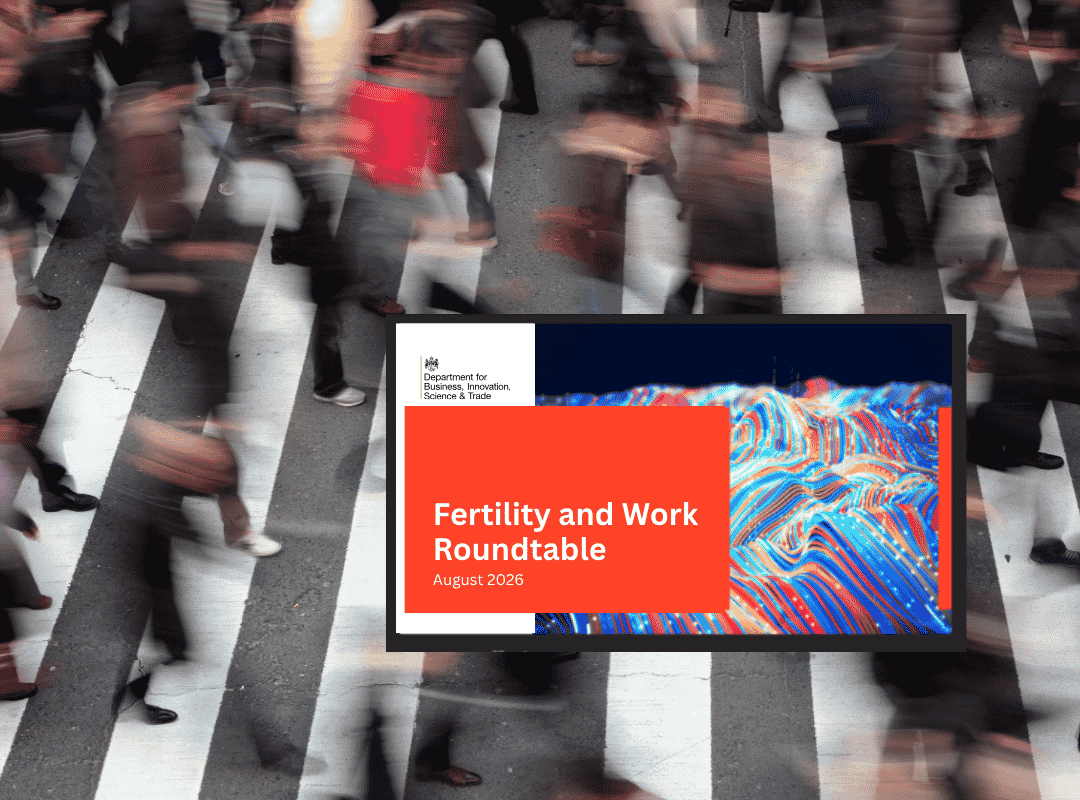
Today, Fertility Action CEO Katie Rollings and Trustee Laura Rose Thorogood joined around 15 representatives from charities, unions and advocacy organisations at an evidence-gathering roundtable hosted by the the Department For Business, Innovation, Science and Trade. The discussion focused on the real experiences of employees undergoing fertility treatment and the barriers they can face at work. There were no policy decisions or proposals announced at the session. Instead, the Government is gathering evidence to better understand the issues and inform future thinking.
Why is fertility in the workplace important?
Fertility treatment can involve frequent appointments, medication, scans, procedures and sometimes treatment cycles that are difficult to predict. At the same time, employees may be dealing with anxiety, uncertainty, disappointment, grief or the financial pressure of paying for treatment.
Trying to fit all of this around a normal working day isn’t always straightforward. An appointment may be confirmed at short notice or medication may need to be taken at a particular time. An employee might be relying on somewhere private to administer an injection or may need time away from work following a procedure. And yet many workplace systems aren’t designed around this reality.
Standard flexible-working processes can require requests weeks or months in advance, while fertility treatment appointments may only be confirmed hours beforehand. For employees, this can create an impossible choice:
Do I tell my employer what’s really happening, or do I try to hide it?
The fear of disclosing fertility treatment
One of the most striking themes from today’s discussion was the issue of disclosure. Evidence shared at the roundtable indicated that around two-thirds of respondents, in the study from Pregnant Then Screwed, did not feel comfortable telling their employer they were undergoing fertility treatment. Of those who did disclose, Rachel from PTS explained, 40% reported negative outcomes, including unfair treatment, bullying, withheld promotion or redundancy.
Another statistic from FMAW’s Eleanor Nickerson-Smith highlighted that 63% of employees take sick leave to conceal fertility appointments rather than disclose the real reason for their absence*. This may certainly make employers stop and think. If employees are using sick leave because they don’t feel safe telling their workplace about fertility treatment, the issue isn’t simply about whether an organisation has a fertility policy. It’s about workplace culture. A policy is only effective if employees feel confident using it.
Fertility treatment affects men too
Fertility in the workplace is sometimes framed primarily as a women’s health issue.
It isn’t.
All men, women and people can experience infertility or sub-fertility and undergo investigations and treatment themselves, and can be deeply affected by fertility treatment and its emotional impact. This was the reason behind us launching the “Fertility Action For Men” Campaign in Parliament last year, in the hope that this continued narrative might progress, and ensure men and non-birthing partners remain included in all aspects of care and consideration throughout their family-building pathway.
The roundtable highlighted additional stigma around men disclosing fertility issues, particularly in male-dominated industries where fertility can become the subject of jokes or workplace “banter” – as Ian Stones from testhim explained. Creating a fertility-friendly workplace means making it clear that fertility is everyone’s issue. Employees shouldn’t have to fit a particular gender or family structure to feel able to ask for support.
Are your workplace fertility policies inclusive?
Another extremely important issue here is language. Many fertility policies are written around an assumed family structure, sexuality or gender-identity – often a heterosexual couple trying to conceive. But of course, in the beautifully diverse world that we live in, families aren’t all the same.
Employees may be:
- single people trying to become parents;
- same-sex couples;
- trans or non-binary people;
- people using donor conception;
- people exploring/using surrogacy;
- co-parents or people in other family arrangements.
If workplace policies don’t reflect this diversity, employees may be left wondering whether they qualify for support at all. This isn’t just a wording issue, we’ve seen through our support groups how exclusionary language can create real barriers to accessing workplace support.
As Laura-Rose, Trustee of Fertility Action and CEO of LGBT Mummies, expertly outlined; a good fertility policy should be inclusive, clear and easy to understand for everyone who needs to reference it.
The practical challenges of fertility treatment at work
Employers who want to support employees undergoing fertility treatment should consider the practical realities. For example;
Flexible appointments
Fertility treatment doesn’t always operate on a predictable timetable. Employees may receive confirmation of appointments at very short notice. Workplace policies need enough flexibility to accommodate this.
Privacy
Some employees need to administer fertility medication during the working day. Do they have a private/comfortable space to do this? Can medication be stored safely if refrigeration is required? And can employees access these facilities without being forced to explain their circumstances to colleagues?
Time off
Employees may need time away from work for appointments, procedures and recovery. Using annual leave or sick leave for every appointment can quickly become exhausting – particularly when someone is already dealing with the emotional impact of treatment. It’s also important to note, that taking a sick day, will likely be a full day of absence, when in fact the employee may only need a few hours.
Different types of employment
Support also needs to consider people who don’t work in traditional full-time roles. Employees on zero-hours or low-paid contracts may lose income when they attend appointments. Self-employed people may have no paid leave at all and small businesses may genuinely want to offer support but lack the HR infrastructure and financial resources of a large organisation.
A genuinely fertility-friendly workplace cannot be designed around only one type of employee or employer.
The emotional impact at work shouldn’t be overlooked
Perhaps the biggest mistake employers can make is thinking fertility support is simply about giving people time off for appointments. It’s much more than that, and interestingly, by looking into your fertility support for your teams, you may find a positive change in absences.
Evidence discussed at the roundtable* found that 99% of more than 1,000 survey respondents reported that fertility treatment had affected their wellbeing*, while 87% experienced anxiety or depression directly linked to treatment*.
People may be trying to concentrate on a meeting while waiting for a test result or going through treatment after work and arriving exhausted the next morning. Some may have experienced a failed cycle/embryo loss, miscarriage or pregnancy loss and still be expected to carry on with their normal responsibilities.
Katie Wood from Maternity Action highlighted the importance of understanding that loss doesn’t just happen in a day – it can be a process over weeks. So if employees have used all their annual leave for appointments, where is the time to rest? For employers, and wider-society, understanding this is essential.
What does a fertility-friendly workplace look like?
Feedback from the meeting suggested that there isn’t one perfect fertility workplace policy – each pathway is different and needs to be treated accordingly. However there are some basic, practical steps employers can take.
A fertility-friendly employer could consider:
-
Fertility leave or flexible time off
Give employees a clear route to attend fertility appointments without having to use annual leave or pretend they’re ill.
-
Confidentiality
Employees shouldn’t have to share intimate medical details with multiple people simply to access support. There are some great support organisations (like Fertility Action!) where employees can be guided to as well.
-
Inclusive language
Make sure fertility policies recognise different languages, cultures, identities, relationships and routes to parenthood.
-
Manager training
Managers don’t need to be fertility experts, but they should know how to respond sensitively and where to direct employees for further support. Clarity of “what’s next” is key.
-
Private facilities
Consider whether employees have somewhere appropriate to administer medication or deal with treatment-related needs.
-
Mental health support
Recognise that fertility treatment can have a significant impact on emotional wellbeing and provide a well-thought-out system of support – whether that’s ERG’s, charity/support, counselling or sharing in-person support events.
-
Education
Fertility education can help remove stigma and make conversations less awkward. Invest in team training, resource packs, well-researched/discreet policies, Lunch & Learns (and if you do it with Fertility Action you’ll be supporting a charity too!).
-
Employee Resource Groups
Where appropriate, safe fertility or family-building Employee Resource Groups can give employees a safe space to connect and share experiences and feel validated in this often-stigmatised area.
-
Support for partners
Don’t forget that fertility treatment can affect partners too. Consider the non-birthing partners equally and that often the psychological and sometimes the physical side will impact them too.
-
Regularly review your policy
Ask employees whether the support actually works in practice – not simply whether the policy exists. (And DON’T file it in the maternity section!)
What is already working?
The good news is that some employers are already taking innovative approaches.
Evidence shared during the roundtable included examples of large employers offering unlimited fertility-related time off. Interestingly, the average amount of time employees actually took was reported to be less than one week, challenging concerns that generous policies automatically result in excessive absence.
Some organisations have introduced anonymous HR codes, allowing employees to request fertility-related leave without having to disclose their situation directly to their manager. Others are investing in fertility education and Employee Resource Groups, helping to create cultural change and improve psychological safety. Union representation has also made a difference in individual cases, demonstrating the value of employees having access to effective workplace representation.
These examples show that supporting fertility at work doesn’t have to mean creating an enormously complicated programme. Sometimes, the most valuable changes are simply about flexibility, privacy, understanding and trust.
Fertility and the law: are current protections enough?
The roundtable also raised important questions about existing legal protections. The Equality Act provides protections relating to pregnancy and maternity, but there are gaps when it comes to fertility treatment and pregnancy loss. For example, pregnancy-related discrimination protections following pregnancy loss are time-limited, while recovery – physically and emotionally – does not necessarily follow the same timetable.
There are also challenges when it comes to demonstrating discrimination linked to an anticipated future pregnancy and fear of not receiving a promotion. Something which is certainly not uncommon for any of us to have witnessed.
We are encouraged to see that the Department of Business and Trade are exploring this important topic. It raised important questions for employers, policymakers and organisations who are supporting people through fertility treatment – and we look forward to seeing the outcomes.
Fertility Action: a resource for fertility in the workplace
At Fertility Action, we believe that fertility support needs to extend beyond clinical care.
People spend a significant proportion of their lives at work, meaning employers have an important role to play in creating environments where employees can navigate fertility treatment without fear of judgement, discrimination or damage to their career. (Organisations such as Fertility Matters at Work and IVFN are also a great place to start if you haven’t explored this before).
Whoever you are, if you or an employee is looking for information about your options, Fertility Action is here to help improve understanding around fertility and support.
The starting point isn’t necessarily a bigger benefits package.
It may simply be asking:
“If someone in our organisation was going through fertility treatment tomorrow, would they know where to turn – and would they feel safe asking for help?”
If the answer is no, there’s an opportunity to do better.
Building better workplaces for fertility
Today’s Government roundtable was an important opportunity to listen to the experiences of people navigating fertility treatment alongside employment.
Although there were no policy decisions made or a consultation timeline confirmed, attendees have been invited to provide further evidence, statistics and case studies as the Government’s evidence-gathering continues.
For Fertility Action, we’ll continue to contribute and engage in these conversations and advocate for better understanding and support.
A fertility-friendly workplace is one where employees don’t have to choose between their health, their hopes of building a family and their career.
And creating that kind of workplace benefits everyone.
Looking for support while trying to conceive?
If you’re currently trying to conceive and would like to connect with others who understand the journey, you can join the Fertility Action Support Group or Online Community.
Join the weekly Support Groups
You don’t have to navigate your fertility journey alone.
Considering inviting Fertility Action charity into your workplace?
We’d love to come and see you! Fertility Action works to improve understanding, support and access for people navigating fertility and family-building journeys.
We believe everyone should be able to access clear, accurate information, appropriate support and compassionate care – including those who are navigating fertility matters in the workplace and we’d love to discuss how we can support your team.
If you’re an employer looking to understand more about fertility support in the workplace, we’d love to hear from you. Contact Fertility Action for further information, resources and updates. We can also happily connect you to FMAW or the IVFN who each provide comprehensive guidance on Fertility in the workplace.