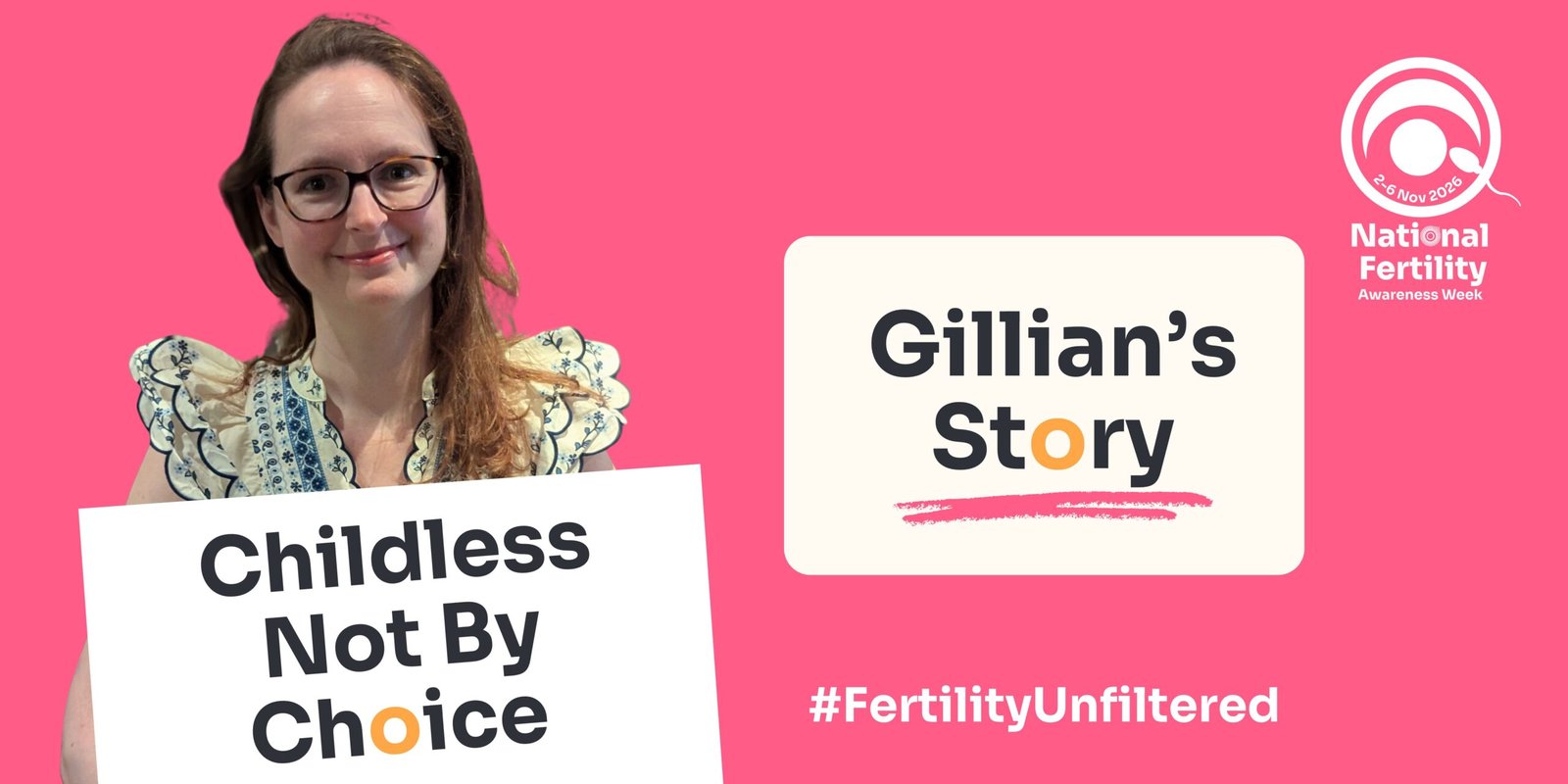
Four years of IVF, two pregnancy losses, and the unexpected reality of life after treatment ends.
If you’d met me fifteen years ago and asked what my future looked like, I’d have given you a very confident answer. Married. Two children. Family home. Perhaps a Labrador. The details were flexible; becoming a mum wasn’t.
What I didn’t realise at the time was that I’d spend more than six years trying to make that future happen, and that the hardest part wouldn’t be fertility treatment itself. It would be what came afterwards.
Looking for answers
When my husband and I started fertility investigations, I assumed someone would find the answer. Instead, test after test came back essentially normal. People said, “At least there’s nothing wrong.” I knew they meant well, but all I could think was: “If there’s nothing wrong, there’s nothing to fix.”
So when we started IVF, it felt like we’d finally found the answer. Daunting, yes, but exciting too.
Do IVF. Get pregnant. Have a baby.
That’s how this works, right?
When IVF becomes normal
Nobody prepares you for how quickly IVF becomes normal. With no medical training, I was suddenly administering drugs through every route possible, including drawing up precise doses for injection. The low point was probably progesterone injections.
A nurse calmly explained they needed to go into the muscle, talked me through avoiding nerves and blood vessels, and sent me home with a bundle of the biggest needles I’d ever seen.
My husband is needle-phobic and I just couldn’t do this one without him. Before he came anywhere near me with the syringe, I sat him down in front of YouTube for almost an hour watching tutorials. I still kept my phone in hand in case he fainted and I needed to call my mother-in-law to come and remove the needle.
Fertility treatment is full of moments that are unintentionally absurd. During embryo transfer, someone carefully covers you with a sheet to preserve your dignity before promptly shining a theatre light between your legs. Meanwhile, you’re staring at a faded picture of a tropical island and trying not to wet yourself because you’ve arrived with a full bladder.
Dignity becomes a surprisingly flexible concept.
Before long, treatment settled into a rhythm. Appointments. Scans. Procedures. Waiting. Phone rings. Results. Repeat.
The loneliest journey
This was the loneliest journey. Hours in waiting rooms full of people just like me. Women clutching folders of notes and test results. We all knew exactly why we were there. Yet nobody spoke. We sat shoulder to shoulder avoiding eye contact, somehow making a deeply shared experience feel incredibly solitary.
Over time, we discovered we weren’t nearly as alone as we’d thought. We actually knew several couples who had been through IVF too. We just hadn’t known because nobody talked about it.
Finishing the class
If I think about the hardest part now, my mind always goes back to our second-last treatment cycle.
By then we’d been trying for years. We’d been through multiple rounds of treatment, transfers and losses. I remember crying on the way to appointments almost every day. Every now and then a thought crept into my head that made me feel like a terrible person.
I wasn’t sure I wanted it to work anymore.
Not because I didn’t want a baby. I desperately did. I just wasn’t sure how much more of myself I could give to the process.
Then, a few weeks after an embryo transfer, I stepped out of a ballet class to answer a call from my consultant. The embryo had implanted. For a few seconds, all I heard was the good news. Then he explained that my blood results suggested I would miscarry.
I remember sitting on the floor in a quiet corridor, crying and hoping no one would walk past. Then I realised I had a problem: how exactly do you walk back into a brightly lit dance studio after a phone call like that? I decided the sensible thing to do was carry on with class. It turns out doing ballet class through tears is harder than you think.
I often think about that evening because it captures something fertility treatment taught me repeatedly. The world doesn’t stop when you get bad news. Sometimes you still have to finish the class. Turn up at the meeting. Make dinner. Carry on.
Our final cycle
Eventually we started what would become our final cycle.
Perhaps we already knew it was the last. For the first time in years, we planned something that wasn’t built around fertility treatment. We booked a safari and worked out the timings so that either we’d be celebrating a successful pregnancy or heading off on the trip of a lifetime.
Another future was finally allowed into the room
The decision to end treatment was surprisingly quiet. Somewhere between a safari, Christmas and countless conversations spoken and unspoken, we reached a point where we knew.
What helped most was a late-night conversation with an old family friend. Their story was different to ours, but it ended in the same place. More importantly, they had built a life afterwards. They were the first person who told me it was OK to stop. Stopping didn’t mean we hadn’t wanted it enough. It didn’t mean we hadn’t tried hard enough. It didn’t mean we’d failed. Sometimes it simply means it’s time to stop.
When grief changes shape
At the time, I thought that would be the end of the story. I genuinely believed that once the treatment stopped, the hard part would be over. No more appointments, medications or waiting. What I hadn’t understood was that ending treatment and processing it are two very different things.
For months afterwards I kept expecting to bounce back. After all, the practical part was over. Only later did I realise that while treatment had ended, the grief hadn’t. It had just changed shape, and that’s the part nobody prepared me for.
We stopped treatment without a baby. It wasn’t the ending we’d planned for. Every now and then I still open a cupboard and find a forgotten fertility medication. Apparently letting go takes a little longer than making the decision.
By Gillian O’Brien
If anything in this story has stirred up feelings for you, please know you’re not alone, and there are people who understand. Alongside Fertility Action, Miscarriage UK offer support and information.