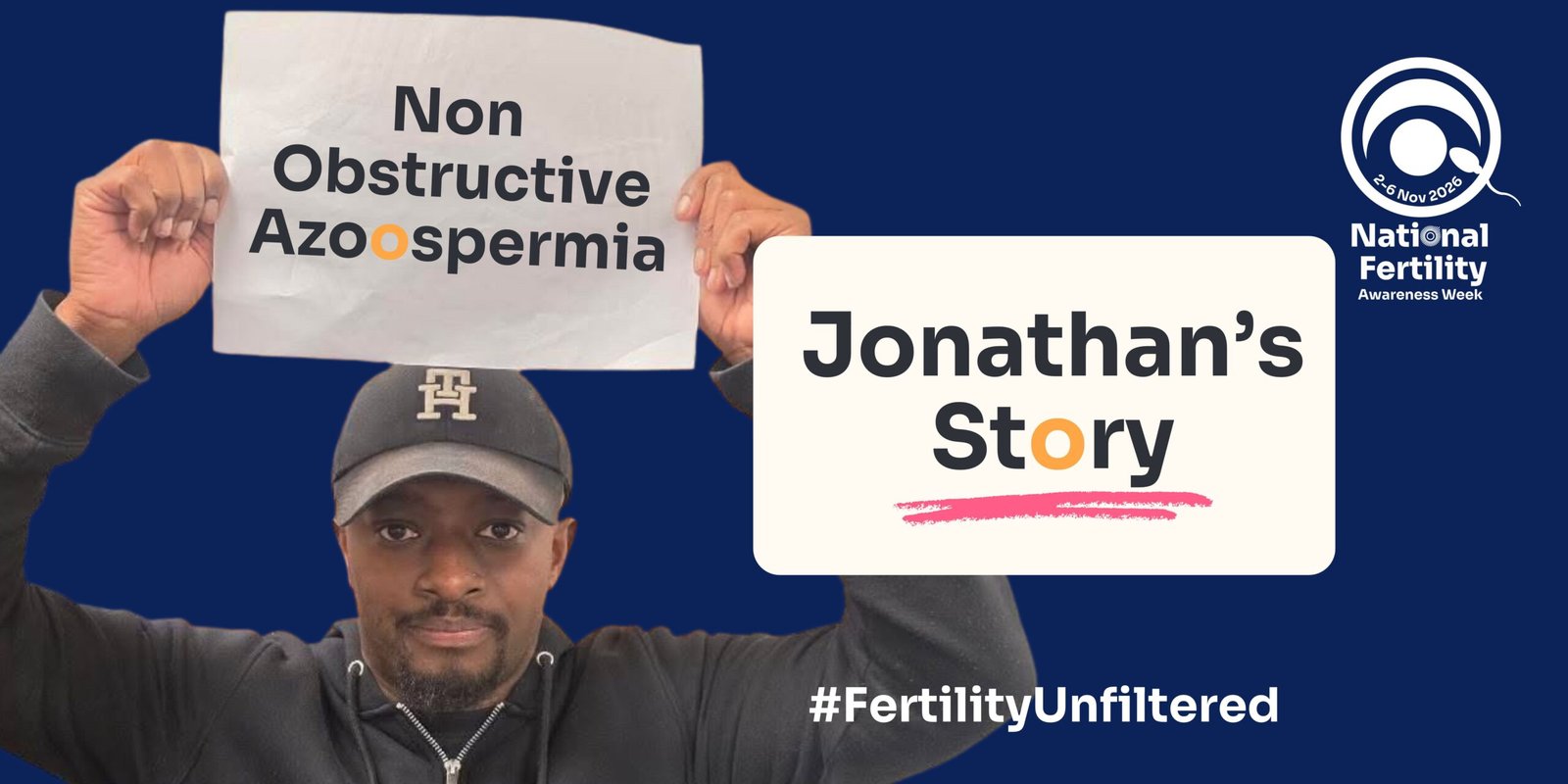
For too long, male fertility has existed in the shadows of conversations about parenthood — misunderstood, under-discussed and burdened by assumptions about what it means to be a man. Jonathan Luwagga is helping to bring that silence into the light. His story asks us to look beyond a diagnosis, confront the myths we have inherited and reconsider how we support men when the future they imagined becomes uncertain.
There are some conversations that society has become remarkably good at avoiding.
Male infertility is one of them.
We have found ways to speak about almost every dimension of modern masculinity, from mental health to fatherhood, from vulnerability to the pressures men face in a world that still expects them to be strong. Yet when the conversation turns to fertility, something changes. Voices lower. Eyes shift. Words become harder to find.
Behind closed doors, men sit with diagnoses they may struggle to understand, questions they may be afraid to ask and emotions they have never been taught how to express. Some carry their uncertainty quietly into relationships, family gatherings and places of worship, performing an outward confidence that conceals an intensely private struggle.
For a man who has imagined becoming a father, the possibility that biological parenthood may not happen as expected can reach far beyond the clinical language of a medical report. It can unsettle his understanding of himself, his future and the place he believes he occupies in the world.
It is within this largely unspoken landscape that Jonathan Luwagga, also known as JK Luwagga, has chosen to tell his story.
His experience of non-obstructive azoospermia — a condition in which no sperm are detected in the semen because of problems with sperm production — brings into focus a reality that remains insufficiently understood: male fertility is not simply a matter of sperm counts and laboratory results. It is also a matter of identity, intimacy, mental health, relationships and, for some, faith.
By speaking about his experience and advocating for greater awareness of male infertility, Luwagga is helping to make room for a conversation that should have been taking place all along.
Because the question is no longer simply why men struggle to talk about fertility. It is why we have built a culture in which so many feel they cannot.
The diagnosis behind the man
A diagnosis can be delivered in a matter of minutes. Understanding what it means to live with it may take considerably longer.
Non-obstructive azoospermia is a condition associated with impaired sperm production. Its causes and implications vary, and an individual diagnosis does not, on its own, tell the whole story about a person’s reproductive options.
But medicine has its own language, and that language, however necessary, can sometimes feel inadequate to the person sitting on the other side of the consultation room.
A clinician can explain what a test has found. What is more difficult to articulate is what the result means to someone who has spent years imagining a different future.
What happens when a man begins to question something he has never previously considered uncertain? How does he explain a diagnosis that touches a subject he may have been taught to associate with his masculinity? Where does he turn when the language of medicine does not quite capture the weight of what he feels?
These are not questions that can be answered by a laboratory result.
Luwagga’s willingness to discuss his infertility brings those questions into public view. It allows us to consider the person behind the diagnosis, rather than reducing his experience to a medical condition.
That distinction matters. Too often, infertility stories are framed around the achievement of a particular outcome: a successful treatment, a pregnancy, the arrival of a child. Those stories deserve their place. But when success becomes the dominant narrative, the experiences of people still living with uncertainty can disappear from view.
Not every fertility journey follows a neat arc from diagnosis to treatment to resolution. Some involve difficult decisions. Some involve grief that returns at unexpected moments. Some require people to reconsider what parenthood might look like. Others remain unfinished.
Their stories are no less worthy of being told.
Luwagga’s contribution lies in helping us recognise that the experience of infertility deserves attention in its own right — not only as a prelude to whatever may happen next.
When fertility becomes a measure of manhood
The stigma surrounding male infertility does not emerge from nowhere. It is reinforced by generations of cultural assumptions about masculinity, sexual potency and fatherhood.
From childhood, many boys absorb the idea that being a man means being capable, self-sufficient and emotionally composed. In adulthood, those expectations can become particularly complicated when a man encounters something he cannot resolve through determination alone.
Fertility is an especially vulnerable point because it sits at the intersection of biology and social expectation.
In many communities, having children is more than a personal aspiration. It is tied to family continuity, belonging, cultural identity and the hopes of parents and grandparents. Questions about when a couple will have children may be intended affectionately, yet for someone experiencing infertility, they can become reminders of a struggle they are not ready to explain.
For men, the pressure can be sharpened by an enduring misconception: that fertility is an uncomplicated extension of masculinity.
It is not.
A man’s reproductive health is determined by biological factors that are neither a measure of his character nor a verdict on his worth. Yet the persistence of this misconception can make an infertility diagnosis feel like a judgement, even when it is nothing of the kind.
The consequences are not merely emotional. Shame can discourage men from seeking medical assessment, asking questions or discussing concerns with their partners. Silence can delay understanding. Misunderstanding can leave couples navigating a complex experience with less information and support than they need.
And so the problem perpetuates itself. Men do not speak because they fear the stigma; the stigma survives because men are not encouraged to speak.
Breaking that cycle requires more than telling men to open up. It requires changing the environment into which they are being asked to speak.
It means creating healthcare services in which male reproductive health is treated as an essential part of fertility care. It means giving men accurate information before a crisis arises. It means ensuring that conversations about infertility include the psychological consequences, not just the clinical findings.
Above all, it means abandoning the idea that a man who struggles with fertility has somehow failed at being a man.
The missing half of the fertility conversation
For years, public conversations about infertility have too often placed women at their centre, with male fertility treated as a secondary consideration or introduced only when a couple encounters difficulties conceiving.
This framing does a disservice to everyone.
Male factors contribute to infertility in many couples, either independently or alongside female factors. Yet awareness of male reproductive health remains uneven, and many men reach adulthood with little understanding of sperm production, reproductive health or the circumstances in which they should seek assessment.
The result is a significant gap between the importance of fertility in people’s lives and the information they receive about it.
We teach young people about sexual health, but reproductive health education does not always adequately explain fertility. Men may understand how to prevent a pregnancy without understanding the biological processes required to achieve one. They may know little about conditions affecting sperm production, the role of hormones or the significance of certain medical histories.
Fertility can consequently become a subject that men encounter seriously only when they are trying to conceive.
By then, the stakes may feel enormous.
A more informed approach would begin much earlier. Schools, healthcare providers and public health campaigns should give boys and men accessible, age-appropriate information about reproductive health. Primary care should provide opportunities to discuss fertility concerns without embarrassment. Fertility services should make clear that assessment of the male partner is not an optional afterthought.
This is not about creating unnecessary anxiety or suggesting that every man should be preoccupied with his fertility. It is about replacing ignorance with understanding, and fear with the ability to make informed decisions.
It is also about recognising that men are not simply supporting characters in someone else’s fertility story. They have bodies, health needs, fears and hopes of their own.
Luwagga’s advocacy helps bring that principle into sharper focus. His story is personal, but the questions it raises are public ones: what do men know about their fertility, where do they learn it, and what happens when they discover that something is not as they expected?
These are questions that healthcare systems, educators, employers and communities can no longer afford to leave unanswered.
The loneliness no one sees
There is another dimension to male infertility that deserves greater attention: the emotional labour of appearing unaffected.
Men may feel pressure to be the steady presence in a relationship, particularly when both partners are struggling with the uncertainty of trying to conceive. They may focus on supporting someone else while postponing their own grief. They may avoid difficult conversations because they do not want to add to the burden their partner is already carrying.
Others may not know how to begin.
The language available to men for discussing infertility can be surprisingly limited. They may find it easier to describe a medical result than to explain the fear beneath it. They may speak about treatment options while avoiding the question of what the diagnosis has done to their sense of self.
This does not mean every man experiences infertility in the same way. Some speak openly from the beginning; others prefer privacy. Some experience profound distress, while others find ways to adapt without feeling that their identity has been fundamentally altered.
There is no single correct emotional response.
What matters is that men have the freedom to respond honestly, without being told either to toughen up or to turn their private experience into a public testimony.
For those who do want support, access to fertility-informed counselling can be invaluable. Partners need opportunities to discuss the experience together, while also recognising that they may be processing it differently. Friends and family need to understand that support does not require having the perfect words.
Sometimes it means listening without immediately offering a solution. Sometimes it means resisting the temptation to reassure someone with promises no one can make. Sometimes it means allowing disappointment to exist without insisting that it be transformed into optimism.
Compassion begins when we stop demanding that people make their pain comfortable for everyone else.
Luwagga’s openness offers an important counterpoint to the expectation that men should carry their difficulties privately. By making his experience part of a wider conversation, he helps create the possibility that another man might recognise his own feelings, find language for them and realise that he does not have to navigate them alone.
That is one of the quieter forms of impact that storytelling can have. It does not necessarily change a diagnosis. It can change what happens after it.
Faith, uncertainty and the search for meaning
For some men, infertility raises questions that extend beyond medicine. It can challenge their understanding of faith, purpose and the future they had expected to build.
Luwagga has spoken about infertility in the context of Christian faith, identity and biblical ideas of fruitfulness. This is an important part of the wider conversation because, for many people, faith is not separate from the way they understand their lives. It shapes how they interpret hardship, where they seek support and how they imagine the future.
Yet conversations about faith and infertility require care.
When parenthood is closely connected to spiritual beliefs, an unexpected diagnosis can raise difficult questions. People may wonder why they are experiencing this particular challenge, how to reconcile their hopes with their circumstances, or how to respond when the answers they seek do not come.
Sometimes, well-intentioned communities make that burden heavier. Infertility may be met with simplistic explanations, unwanted advice or suggestions that imply a person has somehow fallen short spiritually.
Such responses can deepen isolation rather than relieve it.
A more compassionate understanding of faith makes room for uncertainty, grief and unanswered questions. It recognises that hope does not require denial, that vulnerability is not the opposite of strength and that no one should have to defend their faith while navigating a medical diagnosis.
For people who draw strength from religion, faith communities can provide meaningful support: a place to be heard, relationships that endure beyond difficult circumstances and a sense of belonging that does not depend on whether someone becomes a parent.
The important distinction is between offering support and prescribing an explanation.
Infertility does not need to be explained away for the person experiencing it to deserve care. Nor does a man’s life need to resolve according to a particular expectation for it to have meaning.
Luwagga’s willingness to explore these intersections gives the conversation a human depth that clinical discussions alone cannot always provide. It reminds us that fertility is experienced by whole people, whose beliefs, relationships and understanding of themselves are inseparable from the medical facts they receive.
From personal testimony to lasting change
There is power in a personal story, but the responsibility for change cannot rest solely on the people brave enough to tell theirs.
Men who speak publicly about infertility often take on an additional burden: they must navigate their own experiences while helping others understand them. Their openness can be valuable, but it should not become a substitute for proper education, responsive healthcare or institutional accountability.
If we are serious about changing the landscape of male fertility, the conversation must move beyond awareness alone.
First, male fertility education must become routine rather than reactive.
Men should have access to clear, reliable information about reproductive health long before they encounter difficulty conceiving. Education should explain how male fertility works, what can affect it and when medical advice may be appropriate. It should be scientifically accurate without being alarmist, and accessible without being patronising.
Second, fertility care must recognise the man as a patient in his own right.
When a couple seeks help to conceive, both partners deserve appropriate assessment and clear communication. Men should not be left to navigate confusing terminology or receive their diagnosis as an afterthought. Conditions such as azoospermia require careful investigation, and patients deserve explanations that reflect the complexity of their individual circumstances.
Third, emotional support must be built into the journey.
The psychological impact of infertility should not be treated as an optional concern that becomes relevant only when someone reaches crisis point. Fertility services should make appropriate support available, while healthcare professionals should be equipped to recognise the emotional challenges that may accompany diagnosis and treatment.
Fourth, public conversation must become more responsible.
Media coverage, community discussions and awareness campaigns should move beyond simplistic narratives of masculinity and fatherhood. Men should not be reduced to their sperm, their diagnoses or their eventual reproductive outcomes. Their stories should be told with dignity, accuracy and respect for their privacy.
Finally, we need to listen to men themselves.
That means hearing from those who have received a diagnosis, those who are still seeking answers, those who have pursued treatment and those whose journeys have taken different directions. It means including voices from different cultures, communities and socioeconomic backgrounds, recognising that access to information and care is not equal for everyone.
And it means ensuring that the conversation does not disappear once a campaign ends or an awareness month passes.
Real progress is measured not simply by how many people have heard the words male infertility, but by whether men are better informed, whether they can access appropriate care, whether their emotional needs are recognised and whether they feel less alone when they need help.
A different understanding of fatherhood — and of men
It is important to acknowledge that, for many men, the desire to have a biological child is profound. It would be neither honest nor compassionate to dismiss that desire or suggest that a man should simply redefine his ambitions when faced with infertility.
Grief deserves to be taken seriously.
But we must also question the cultural framework that can make biological fatherhood appear to be the ultimate proof of male worth.
Fatherhood can be a deeply meaningful experience, but it is not a universal measure of character. The ability to produce sperm does not guarantee that someone will be a loving father, just as an infertility diagnosis does not diminish a person’s capacity to care, nurture, teach or contribute to the lives of others.
For some men, the future may involve medical treatment or assisted reproduction. For others, it may include different routes to building a family. Some will need time to understand what they want. Others may choose paths that do not involve parenthood.
These decisions are personal, and no one should be hurried towards a particular version of acceptance.
The point is not to make infertility seem inconsequential. It is to ensure that the pain associated with it is not compounded by the belief that a man’s entire identity is at stake.
We can acknowledge the importance of biological fatherhood while rejecting the notion that it determines a man’s value. We can respect grief without treating it as evidence of inadequacy. We can support men in exploring their options without assuming that every story must end in the same way.
That is a more generous understanding of masculinity – one grounded not in biological performance, but in the recognition of human complexity.
The courage to change what comes next
What makes Luwagga’s story significant is not simply that it draws attention to a condition many people know little about. It is that it challenges the terms on which we have been discussing male fertility.
For too long, men have been expected to confront infertility in a culture that offers them limited preparation for it, limited language with which to describe it and, in some circumstances, limited support once it becomes part of their lives.
We cannot reasonably ask men to be more open while leaving the stigma intact. We cannot tell them to seek help without making that help accessible. We cannot celebrate vulnerability in principle and then allow ridicule, misinformation and silence to shape the experience of those who reveal something deeply personal.
Changing this landscape requires a collective effort: clinicians willing to look beyond test results, educators prepared to address reproductive health honestly, communities able to respond without judgement, and institutions willing to make male fertility a sustained public health priority.
It also requires writers, journalists and advocates to tell these stories with care — resisting the temptation to turn a complex human experience into either a tragedy or an uncomplicated tale of triumph.
Jonathan Luwagga’s journey belongs in a broader conversation about what happens when men are given the opportunity to speak about something they have long been encouraged to conceal.
The measure of that conversation will not be whether every man feels compelled to tell his story. Privacy must remain a choice. Nor will it be whether every infertility journey arrives at a happy ending.
It will be whether the man who receives a diagnosis is met with understanding rather than shame. Whether the young man learning about reproductive health understands that fertility is a medical issue, not a test of his masculinity. Whether couples can approach infertility as a shared challenge, with both partners properly supported. Whether faith communities can offer comfort without blame, and whether healthcare systems can recognise the person behind the clinical findings.
Perhaps, most importantly, it will be whether we learn to see men in their entirety, rather than through the narrow expectations that have shaped so much of the conversation about their bodies.
The silence surrounding male infertility was never inevitable. It was built, over time, through assumptions, omissions and discomfort. What has been built can be changed.
Luwagga’s story is one contribution to that change. Its wider significance lies in the conversations it makes possible — conversations about health, identity, faith, vulnerability and the kind of society we want to create for men facing an uncertain future.
A fertility diagnosis may alter the course a man imagined for his life. It should never strip him of his dignity, his place in his community or his right to be understood.
And perhaps that is where a different story begins: not with the demand that men prove their strength by enduring in silence, but with the recognition that they should never have had to endure it alone.
By Jonathan Luwagga
Editorial note: This article draws on publicly discussed aspects of Jonathan Luwagga’s infertility journey and general medical information about male infertility. It does not imply that his diagnosis determines his treatment options or family-building outcomes. Individual medical circumstances vary, and personal details should be confirmed with reliable primary sources before publication
If anything in this story has stirred up feelings for you, please know you’re not alone, and there are people who understand. Alongside Fertility Action, Swimmers Charity, testhim and The Male Fertility Hub offer support and information.