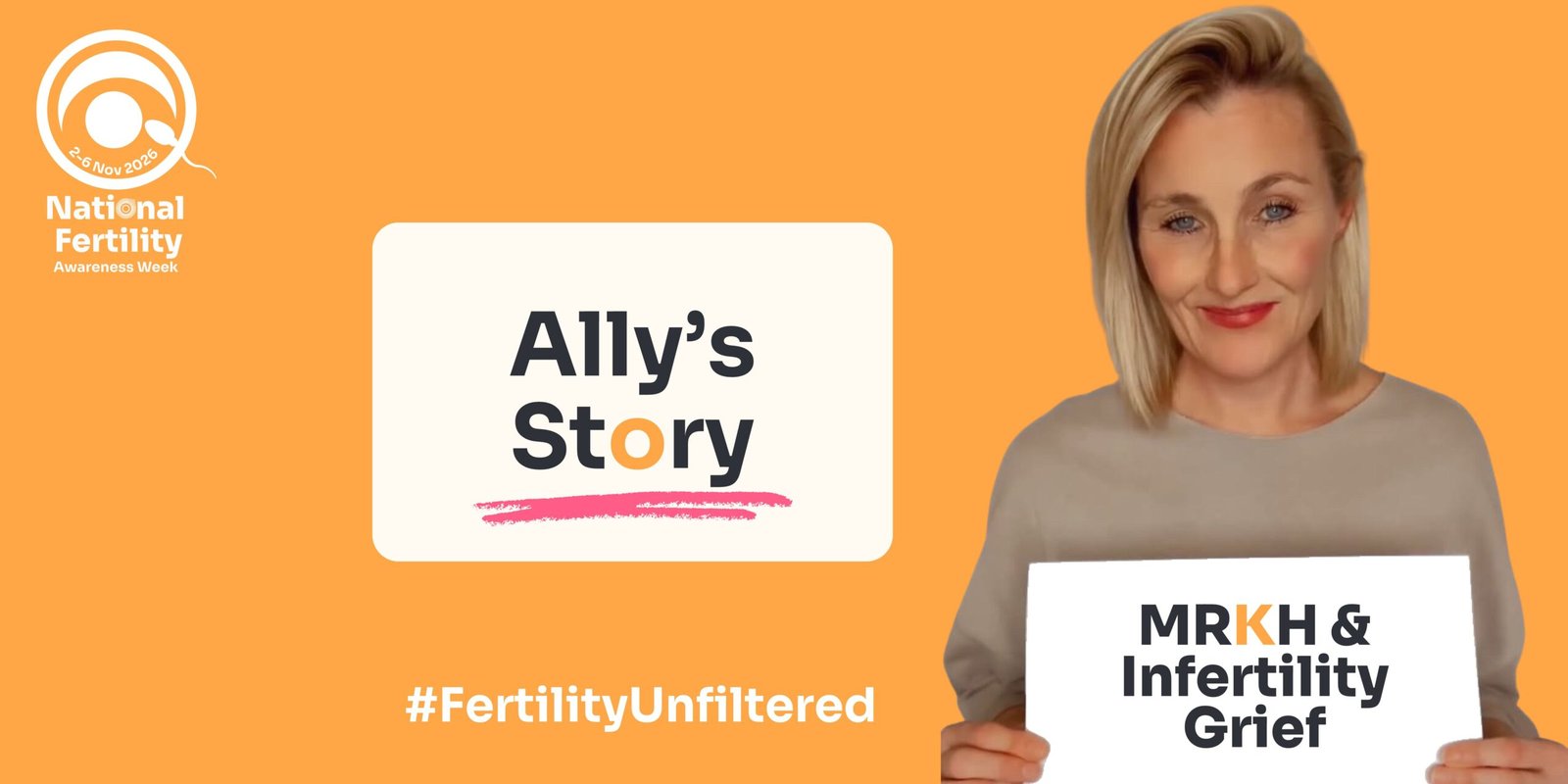
For National Fertility Awareness Week, we’re sharing an extract from Ally Hensley’s memoir, Vagina Uncensored: A Memoir of Missing Parts. Ally was diagnosed with MRKH syndrome at sixteen. Here, she writes about infertility grief, the expectations placed on women, and what it means to unlearn womanhood.
It waited there for years. This dusty tote bag stuffed with sanitary products, sitting, patiently, at the back of my mother’s wardrobe. I waited with it. I believed that ‘any minute now’ my ticket to womanhood would come. At sixteen I learned that I was waiting in vain, my period would never come. As for my ticket to womanhood? It would take me years to realise that, despite all I’d been told, my period wasn’t what made me a woman.
A diagnosis at sixteen
I was so small, as I sat on the hard chair in my doctor’s office as he told me that I was born without a womb, cervix and vagina. Externally, you’d never know (cue, a vulva is not the same as a vagina). It was just after my sixteenth birthday and I struggled to wrap my brain around my congenital condition, known as Mayer–Rokitansky–Küster–Hauser Syndrome (MRKH). I learnt that my body hit a genetic pothole between the 6–8-week gestational period. This is when our bodies form our reproductive system. I learned that I’d never be able to carry a baby and my vagina, failed to form. I had to grieve not just my own infertility but also a whole concept: womanhood. I had to unlearn my fantasies, put there by others, as to what a woman is.
But first. I had a vagina to build.
For a long and traumatic nine months, for twenty minutes both morning and night, I would insert pink, hard tubes into this fingernail-sized dimple and push hard. Eventually, this routine requiring a white-knuckled grip would create a vagina.
Some 30 years later, I will never forget the position I had to get into to force a dilator into my body – flat on my back with my feet on the floor and my knees apart.
You could say, I lost my virginity to myself.
However, I was always going to remain infertile. As my body formed ovaries, my oestrogen levels were firing. I had curves, big boobs, and the external characteristics a female body would ‘typically’ see.
I refuse to use the word normal.
Normal is an incredibly dangerous word when describing humans as there is no such thing. Humans are complex, perfectly inconsistent, and unique.
After nine months, spent in my bedroom doing the unthinkable as a child – making a vagina – I went out in the world – trying so hard to protect this secret – as whenever I tried to open up I was met with head-tilts asking, “do you look like Barbie down there?”
Fifteen years of excess
Riddled with trauma, I learnt how to dampen the memories by doing EVERYTHING to excess; boys, booze, and bingeing. This would be my life for fifteen years.
Until a series of turnaround moments (I want to say gracefully) that forcibly led me to a longing to recover and make peace with my past. As a self-confessed ‘glass-half empty’ woman, I could no longer be a passenger in life, waiting for a life refund that was never owed to me in the first place. But most importantly, I was confronted with what was a necessary but unexpected question: what really defines a woman?
Could I still be a mother?
Thankfully, in my thirties I found peace with my condition, and co-founded an organisation to support other MRKH sufferers. However, my biological clock also started to chime – but was it my own maternal instinct or societal expectation causing it? I never ruled out becoming a mother, but I never totally ruled it in either. I never talked openly about motherhood in my relationships, as the partners I chose weren’t asking that of me – my subconscious attempt at avoiding a sense of failure.
Was it all, “a little too late?”
I was 30 years old when I emerged from those hedonistic, excessive years – healing from my lost teens and twenties but suddenly with another mission: I was going to give womanhood a red hot go. All I’d been sold up to that point was that womanhood equalled motherhood… and I could still ‘achieve’ that dream.
I walked into an IVF clinic with my pregnant best friend at my side, to explore egg retrieval for the purpose of egg freezing. There was no man beside me, no father currently on board with this plan (I was seeing someone at the time… but more on him later). After that appointment, for one year, I did everything I could to determine if I wanted and could become a mother. I was offered the gift of all gifts – another woman’s womb to carry my unborn and dreamt-up child, a surrogate. I had the money in the bank and the test results to confirm my body had a healthy egg-count.
After endless hours of watching YouTube videos of hopeful IVF couples and envisaging what ‘she’ would look like, I began to realise that perhaps infertility was not inevitable. I created an Excel spreadsheet and titled it ‘Esme’ – the name I would bestow on my daughter if I ever were to have one.
However, a clumsy IVF disclosure to the man I was dating at the time, led to a response that left me unable to swallow what spit I had left, “Ally, this is a great idea … for you and your future partner”.
I contemplated; can I do this alone?
I couldn’t.
I didn’t just want a child; I wanted a family.
Maybe, I wanted an idea.
After one final and disheartening appointment with my IVF specialist, I put my medical files in the bin, I shut my bedroom door and cried. I made the hardest phone-call to my surrogate and said, “Thank you, but no thank you”.
Oh grief, there you are again.
Tackling the taboo
The way I share my story publicly; about living with a rare and hugely taboo medical condition is not for the fainthearted. I tackle taboo head-on, unforgivingly and proudly. I often confess my scrappy relationship with relationships, the masterpiece that is my custom-made vagina, and how this body part has influenced how I exist in the world.
I share funny anecdotes of how I’ve announced to first dates, ‘Gee, you like my vagina? I made it myself,’ and why I am a movement maker and fierce advocate in the world of women’s health. So much of life has found itself in a creative container about my womb-less life, and how crippling infertility grief can be.
Infertility: it’s not fair or unfair. It’s not to be pitied or disregarded, and it is the invisible grief that most will never talk about. The inner dialogue for infertility is that of subtle sadness, disguised aggression and palpable fear. Whether you ever desired to be a parent or not is quite irrelevant – but when you are questioning the evolutionary pothole in the road that threatens empty Christmases or not feeling ‘that kick’ for the first time, there is only one thing to do – and that’s talk about it.
Infertility grief continues to flip my perspective on a daily basis. It is never truly curable, the loss of motherhood. So many – too many – people are grieving quietly. Staggeringly, 1 in 6 people experience infertility and 1 in 4 experience miscarriage or infant loss. Yet, women and men are swaying quietly.
So here I am, at 45 years old, kick starting a campaign that reminds us that, despite the toxic message that the ability to bear children is part and parcel of being a woman, it isn’t. It’s not the defining factor. To do this, I had to ‘unlearn everything I knew about womanhood’.
For the most part, I’ve learnt to ‘manage’ my infertility grief. I no longer leave a room when I hear a baby cry. I have baby shower boundaries: I politely decline or stay no longer than an hour. I’ve not watched the Netflix film, Joy, about the British pioneers who invented IVF.
Owning every feeling
Part of overcoming infertility grief is owning all our feelings: the good, the bad, and the socially taboo.
Because, while mums-to-be have pregnancy cravings, I had different maternal cravings:
I wanted a period: not for the bleeding but for what menstruation symbolises — a possible baby.
I wanted labour contractions followed by the “oxytocin high” of delivery — because apparently, there is no better feeling than love for your newborn.
I’d love to hear my children bicker as we pinball between after-school clubs and birthday parties.
As someone who emotionally outsources my trauma (mainly to the internet!), I searched for answers as to why my dormant infertility triggers were resurfacing.
And I found I wasn’t alone.
Yet, staggeringly, we continue to learn about the huge number of couples experiencing infertility. We see billboards and media, pictures of men and women clutching newborns, advertising top-notch IVF clinics, showing us that ‘the family dream’ can be achieved.
In quiet corners, away from the multi-dollar industry of baby-making, people still whisper of IVF as though infertility is a failure.
But there is no failure in infertility. I’ve never met more determined parents than those who worked hard to become a family.
Fear, and then hope
And, then comes fear. I fear that I will not overcome infertility grief, and I fear that with every year, the space around me will grow. I fear that I will never get these words published, despite this book being a dream for the last ten years. I fear that my closest friends will forget about me, as they continue their lives in every country but the one I am in.
Don’t worry, there is a point to my fear list.
Despite the fear, there is hope.
Even when I am unable to predict – and trust me, as a Taurean I like to predict – I know that I will always bounce back. I am someone who openly owns my depression. I take a pill every night at 7 pm to balance out what my brain cannot. This pill may be in my life forever or, one day, I may stop taking it. I am content and accepting either way.
No longer do I need to stand behind a charity to tell my story. I don’t need to make love drunkenly in the dark, because I know that my body is worthy. I am not longing for the day that my life will start, because today, I am in the yummy thickness of my own story. And finally, I trust myself to make good decisions.
Honestly, here’s to the people walking the infertility tightrope between acceptance and pining.
So, what does it mean to ‘unlearn womanhood’?
The idea of unlearning womanhood is about challenging and dismantling societal norms and expectations of what it means to be a woman, and rejecting the idea that there is a single, monolithic definition of womanhood. I needed to question everything, accept that the only thing normal in this world is difference, and discover new drop-down menus that don’t exist yet. You do not need to be a mother to be a woman. You do not need to have a vagina to be a woman. You do not need to bleed to be a woman. And you certainly don’t need to justify your definition of womanhood, to be a woman.
A friend once said to me, “Ally, the world needs all sorts of mothers and women – friends, advocates, educators, speakers, and healers. You can do womanhood your way”.
So, that is what I am doing.
Unlearning womanhood and motherhood and finally, doing it my way.
This is an extract from Vagina Uncensored: A Memoir of Missing Parts by Ally Hensley. Our thanks to Ally for letting us share it.
For more information about MRKH, visit MRKH Connect. You can buy Ally’s memoir here.